

Business Operation · 2025
In this section22 topics
- Corporate Information4 items
- Dividend Policy2 items
- Major Shareholders3 items
- Business Strategies Overview7 items
- Material Changes & Developments1 item
- Use of Proceeds from Securities Offerings1 item
- Commitments Made in the Registration Statement1 item
- Group Operating-Structure Policy1 item
- Companies Where the Company Holds ≥10%1 item
- Shareholders with Potential Conflict of Interest1 item
- Relationships Among Major Shareholders2 items
- Shareholders' Agreement1 item
- Shareholding Diagram (Group Structure)3 items
- Income Structure4 items
- Product / Service Characteristics3 items
- Research & Development6 items
- Assets Used in the Business4 items
- Marketing Policy & Competition3 items
- Procurement of Products & Services8 items
- Projects Under Construction1 item
- Debentures & Bills of Exchange2 items
- Convertible Securities1 item
Corporate Information
Company Name
CP AXTRA PUBLIC COMPANY LIMITED
Telephone
0-2067-8999
Website
www.cpaxtra.com
ir@cpaxtra.co.th
Dividend Policy
Dividend Policy
The Company has the policy to pay dividends of not less than 40% of the net profit based on the consolidated financial statements after deducting income taxes and legal reserves in each year. However, the dividend payout ratio may be changed depends on the operating results, the company’s financial position, economic situation, the ability to repay the principal and interest in accordance with the debt covenants including future investment plans.
Historical Dividend Payments
| This Year | Last Year | 2 Years Ago | 3 Years Ago | 4 Years Ago | Metric | Description |
|---|---|---|---|---|---|---|
| 0.9 | 1.61 | 0.82 | 0.73 | 2.38 | Net profit per share (Baht : Share) | Net profit per share (baht : share) |
| 0.71 | 0.71 | 0.57 | 0.51 | 0.72 | Dividend per share (Baht : Share) | Dividend per share (baht : share) |
| 0 | 0 | 0 | 0 | 0 | Dividend stock ratio (Number of original shares: dividend shares) | Ratio of stock dividend payment (existing share : stock dividend) |
| 0 | 0 | 0 | 0 | 0 | Dividend share value per share (Baht : Share) | Value of stock dividend per share (baht : share) |
| 0 | 0 | 0 | 0 | 0 | Total dividend payment value (Baht : Share) | Total dividend payment (baht : share) |
| 79 | 70 | 70 | 70 | 40 | Dividend payout ratio to net profit (%) | Dividend payout ratio compared to net profit (%) |
| 0.18 | 0.18 | 0.18 | 0.18 | 0.4 | Dividends from the first half operating results (Baht:Shares) | |
| 0.53 | 0.53 | 0.39 | 0.33 | 0.32 | Dividends from second half operating results (Baht:Shares) |
Business Strategies Overview
Introduction
In 2025, the Board of Directors reviewed and approved the Company's vision, mission and strategic planning to ensure that executives and employees have the same goals in which the Company will operate the business for the greatest benefits to shareholders and all stakeholders.
In addition, the Company has monitored operations with the strategic planning by comparing the actual performance with the strategic goals that the Company has been set.
Chairman's Message
In a world defined by rapid change, the sustainable growth of an organization is not measured solely by the numbers of its branches but rather begins with how deep and strong “taproots” that firmly committed to upholding the right values.
For CP AXTRA Public Company Limited (“the Company” or “CP AXTRA”), good governance is the taproot; symbolized the foundation of the organization, and it forms the foundation of our business operations, which is based on principles of ethics, transparency, and responsibility towards all stakeholders. Since we believe that good governance is not merely a framework for oversight, it is about being aware of the well-being and challenges of others and growing together in a balanced way across economic, social, and environmental dimensions.
CP AXTRA grows through engagement and connection with diverse stakeholders, ranging from customers, partners, entrepreneurs, employees, communities, and an entire society. These stakeholders play a vital role in driving
the country's economy, distributing income throughout the value chain, and our mission is to meaningfully address
the needs of all sectors, bringing 'change' to 'fulfill' the quality of life, health, happiness, and well-being.
The Company is committed to becoming Asia’s leading retail and wholesale platform through seamless integration
of B2B and B2C channels across all touchpoints to better meet customer needs through technology, innovation, and operational excellence driven by highly skilled personnel and connecting business partners in a sustainable manner.
CP AXTRA’s strategic framework drives balanced and sustainable growth across its retail and wholesale businesses.
This framework encompasses regional market expansion, private label product development, technology and digital transformation for customer understanding, efficiency, and talent development at all levels, promoting clean energy throughout the value chain, and collaborations with partners and businesses. The goal is to create a platform of opportunity that generates tangible value for the economy, society, and the environment.
In terms of products and services, the Company prioritizes the quality of food and health products, coupled with its role as a platform of opportunity, supporting entrepreneurs, small, and medium-sized enterprises (SMEs) through knowledge transfer, understanding of market needs, sales channels, and access to international markets, in order to achieve inclusive and sustainable economic growth.
In terms of operations, the Company is committed to utilizing digital technology, artificial intelligence (AI) , and automation to enhance efficiency and create truly personalized customer experiences. Furthermore, the Company is developing leased spaces and shopping malls into the ‘Happy Mall’ concept that caters to the lifestyles of people of all ages, becoming destinations where visitors feel good, experience an improved quality of life, and share meaningful experiences together.
CP AXTRA is committed to responsible business practices and to fostering balanced, long-term growth-symbolized by
a tree with a deep, strong taproot and steady branches that provide enduring value to society. On behalf of the Board of Directors, I would like to extend my heartfelt gratitude to stakeholders for the vital contributions in driving the organization towards a sustainable future together.
Vision
"To bring about change for how life could be better fulfilled with good health, love, joy, and wellbeing."
Objectives
N/A
Goals
"To become the number one B2B and B2C retailer in Asia, combining both online and offline platforms, by fulfilling our customers’ daily needs with technology, innovation, and operational excellence, together with individuals and partners in a sustainable way.”
Business Strategies
To build a future-ready workforce through structured workforce planning, upskilling in artificial intelligence (AI), and the development of a strong next-generation leadership pipeline.
To strengthen a high-performance working culture by embedding the CP Group’s core values to enable faster decision-making and enhance agility across both management and operational execution.
To increase technology self-reliance through end-to-end system integration and the adoption of AI-driven automation to enhance productivity and reduce operating costs.
To enhance profitability by expanding private label products and leveraging AI for merchandise planning, pricing optimization, and store layout management.
To elevate food destination leadership by reinforcing leadership in fresh food and value offerings, while accelerating the expansion of ready-to-eat, ready-to-cook, and innovative product categories.
To strengthen the health and beauty segment through curated product assortments that address customer wellness needs and evolving lifestyle preferences.
To transform the mall business into a community with the ‘Happy Mall’ concept by optimizing tenant mix, refurbishing stores, and enhancing common areas and activities to increase customer attraction and engagement.
To scale e-commerce growth by accelerating online expansion through new customer acquisition, faster fulfillment, and platform enhancement.
To expand store networks through the right store formats in high-potential locations, while leveraging partnerships to accelerate opportunity in the international market.
To drive excellence through product and process innovation, with a strong focus on carbon neutrality, zero food waste, and the creation of an opportunity platform for the Company stakeholders.
Other Information
| Name | Description |
|---|---|
| Business Structure and Operating Performance | CP Axtra Public Company Limited ("the Company") is formed by the amalgamation of CP Axtra Public Company (Limited) ("CPAXT (before the amalgamation)") and Ek-Chai Distribution System Company Limited ("Ek-Chai") under Our vision is to bring about change for how life could be better fulfilled with good health, love, joy, and wellbeing. The Company and its subsidiaries believe competitive advantage in wholesale includes, among others, its status as On 1 October 2024, CPAXT (before the amalgamation), which operated the wholesale business under the brand "Makro" and Ek-Chai which operated the retail business in Thailand under the brand "Lotus's" and rental space management business in Thailand, have been amalgamated to the Company. The amalgamation primarily aims to restructure |
Material Changes & Developments
Material Changes & Developments
| Year | Description |
|---|---|
| 1,988 |
|
| 1,989 |
|
| 1,994 |
|
| 1,996 |
|
| 2,001 |
|
| 2,002 |
|
| 2,003 |
|
| 2,005 |
|
| 2,007 |
|
| 2,009 |
|
| 2,010 |
|
| 2,012 |
|
| 2,013 |
|
| 2,014 |
|
| 2,015 |
|
| 2,017 |
|
| 2,018 |
|
| 2,019 |
|
| 2,020 |
|
| 2,021 |
|
| 2,022 |
|
| 2,024 |
|
| 2,023 |
|
| 2,025 |
|
Use of Proceeds from Securities Offerings
Is There Money Raised from a Securities Offering Still to Report On?
No
Commitments Made in the Registration Statement
Are There Commitments or Conditions from an Offering or Listing?
No
Group Operating-Structure Policy
Description
The company operates in wholesale and retail business of consumer goods and the mall management. The wholesale business consists of wholesale store business in Thailand and overseas, under the brand name “Makro” and “LOTS Wholesale Solutions, and the Food Service business, which is importing and distributing premium food products with storage and delivery services both in Thailand and abroad. Retail business of consumer goods and mall management in Thailand and Malaysia are operated under the brand name "Lotus’s".
Companies Where the Company Holds ≥10%
Companies (≥10% Holding)
| Company Name | Address | Province | Zip Code | Telephone | Fax | Business Type | Security Type | Shares | Paid-up Shares |
|---|---|---|---|---|---|---|---|---|---|
| Makro ROH Company Limited | 1468 Phatthanakan Road, Phatthanakan Sub District, Suan Luang District | Bangkok | 10250 | 0 2067 8999 | 0 2067 9044 | Providing teachnical and supporting services to the Group | Common shares | 83,970,000 | 83,970,000 |
| ARO Commercial Company Limited | 322, Upper Pazundaung Road, Sat San Ward, Mingalar Taung Nyunt Township, Yangon, Myanmar 11221 | (95) 9770 330 003 | Wholesales and retail operator and related business | Common shares | 3,446,000 | 3,446,000 | |||
| Makro (Guangzhou) Food Company Limited | Room 1124, No. 193, Zhongshan 5th Road, Yue Xiu District, Guangzhou, China | - | Wholesales and retail operator and related business | Common shares | 0 | 0 | |||
| CP Wholesale India Private Limited | 7th & 8th Floor, WeWork BlueOne Square, 246, Phase IV, Udyog Vihar, Gurugram -122016, India | (91) 124 447 9000 | Wholesales and retail business | Common shares | 141,600,000 | 132,999,998 | |||
| Makro (Cambodia) Company Limited | 5734, Street 1003, Bayab Village, Sangkat Phnom Penh Thmey, Khan Sen Sok, Phnom Penh, Cambodia | (855) 23 977 377 | Wholesale and retail operator and related business | Common shares | 6,800,000 | 6,800,000 | |||
| Siam Food Services Limited | 2439 Old Paknam Railway Road, Prakhanong, Klongtoey | Bangkok | 10110 | 0 2782 6000 | 0 2782 6009 | Importing and trading of food product from international and domestic sources and providing freight, delivery rental and storage services | Common shares | 34,870,000 | 34,870,000 |
| Indoguna Vina Food Service Company Limited | No. 248A, No Trang Long Street, Ward 12, Binh Thanh District, Ho Chi Minh City, Vietnam | (84) 907 091 188 | (84) 28 3995 6756 | Trading, distribution, import and expot food products | Common shares | 0 | 0 | ||
| Indoguna (Cambodia) Company Limited | Building C, Unit A10&A11, 1st Floor, Phum Bonla Saet, Sangkat Khmuonh, Khan Sen Sok, Phnom Penh, Cambodia | (855) 2390 1369 | Importing and trading of food related products | Common shares | 650,000 | 650,000 | |||
| Indoguna (Singapore) Pte. Ltd. | 36 Senoko Drive, Senoko Industrial Estate, Singapore 758221 | (65) 6755 0330 | (65) 6755 9522 | Manufacturing, trading, importing and exporting of food related products | Common shares | 4,800,000 | 4,800,000 | ||
| Indoguna Dubai L.L.C. | Al Quoz Industrial Area 4, Building No. 24, Road No. 25, P.O. Box 123125, Dubai United Arab Emirates | (971) 4 338 6304 | Importing and trading of food related products | Common shares | 1,800 | 1,800 | |||
| Indoguna Lordly Company Limited | Unit 5A & Unit 7B, Sing Mei Industrial Building, 29-37 Kwai Wing Road, Kwai Chung, Hong Kong | (852) 2730 2025 | (852) 2730 2024 | Manufacturing, trading, importing and exporting of food related products | Common shares | 10,110,000 | 10,110,000 | ||
| Indoguna Muscat Limited Liability Company | Al Harm, Barka, Sourth Al Batinah Governorate, P.O. Box 869, Postal Code 115, Muscat, Sultanate of Oman | +96892490280 | Importing and trading of food related products | Common shares | 300,000 | 300,000 | |||
| Just Meat Company Limited | Unit 5A & Unit 7B, Sing Mei Industrial Building, 29-37 Kwai Wing Road, Kwai Chung, Hong Kong | (852) 2730 2025 | (852) 2730 2024 | Importing and trading of food related products | Common shares | 1,000 | 1,000 | ||
| Maxzi The Good Food Restaurant & Cafe L.L.C. | Al Shafar Investment Building, Shop No. 20, P.O. Box 126113, Al Quoz 1, Dubai, United Arab Emirates | (971) 4 395 3988 | Restaurant and minimart | Common shares | 8,000 | 8,000 | |||
| Maxzi Global FZCO | Dubai Silicon Oasis, P.O. Box 25748, Dubai, UAE | - | Restaurant franchise management business | Common shares | 5,000 | 5,000 | |||
| Retail Properties Co., Ltd. | 313 C.P. Tower Bldg. 1 Fl. Si Lom Rd. Silom, Bang Rak, | Bangkok | 10500 | 02 247 3737 | Renting and operating of self-owned or leased of non-residential buildings | Common shares | 2,100,000 | 2,100,000 | |
| Lotuss Money Services Limited | 550 Krungsri Ploenchit Tower Bldg. Phloen Chit Rd. Lumpini, Pathum Wan, | Bangkok | 10330 | 1712 | 02-627-8615 | Credit card | Common shares | 20,800,000 | 20,800,000 |
| Synergistic Property Development Co., Ltd. | 999/9 Rama I Rd. Pathum Wan, Pathum Wan | Bangkok | 10330 | 02-667-5555 | 02-264-5570 | Property business | Common shares | 4,650,000 | 4,650,000 |
| Sukhumvit Mixed-Use Co., Ltd. | 18 True Tower Bldg. Ratchadaphisek Rd. Huai Khwang, Huai Khwang | Bangkok | 10310 | - | Real estate development for rental as an office building and commercial office | Common shares | 84,474,000 | 84,474,000 | |
| Sukhumvit Living Co., Ltd. | 695 Moo. 12 Bang Kaeo, Bang Phli | Samut Prakarn | 10540 | - | Property business | Common shares | 35,000,000 | 35,000,000 | |
| Axtra Future City Freehold and Leasehold Real Estate Investment Trust | 111, 10th Floor, Unit 1001/1, True Digital Park West, Sukhumvit Rd., Bang Chak, Phra Khanong | Bangkok | 10260 | 06-3848-4677 | Invest in Freehold & Leasehold of properties which comprises of 23 shopping malls (Lotus's) | Common shares | 2,337,282,928 | 2,337,282,928 | |
| Axtra Future City Property Reit Co., Ltd. | 111 True Digital Park West Bldg. 10 Fl. Room 1001/1 Sukhumvit Rd. Bang Chak, Phra Khanong, | Bangkok | 10260 | - | Trust for investment in property business | Common shares | 3,500,000 | 3,500,000 | |
| Renewed Hope Pte. Ltd. | 105 Cecil Street, #22-11, The Octagon 069534, Singapore | Foreign country | - | - | - | Holding business | Common shares | 2,100,000 | 2,100,000 |
| C.P. Retail Development Company Limited | No.629/1 Nawamintr Road, Kwaeng Nuanchan, Khet Buengkoom Bangkok | Bangkok | 10230 | 02-797-9000 | 02-797-9884 | Retail business and shopping center | Common shares | 158,521,241 | 158,521,241 |
| Lotuss Stores (Malaysia) Sdn Bhd | Level 3, No.3, Jalan 7A/62A, Bandar Menjalara, 52200 Kuala Lumpur, Malaysia | Foreign country | 52200 | 03-6287 6000 | 03-6272 8770 | Retail business and shopping center | Common shares | 56,000,000 | 56,000,000 |
| Lotuss Stores (Malaysia) Sdn Bhd | Level 3, No.3, Jalan 7A/62A, Bandar Menjalara, 52200 Kuala Lumpur, Malaysia | Foreign country | 52200 | 03-6287 6000 | 03-6272 8770 | Retail business and shopping center | Preferred shares | 60,000,000 | 60,000,000 |
| Smart Distribution Service Company Limited | 629/1 Nawamintr Road, Kwaeng Nuanchan, Khet Buengkoom Bangkok | Bangkok | 12130 | 02-797-9000 | 02-797-9884 | Distribution center business | Common shares | 1,900,000 | 1,900,000 |
| Axtra Growth Plus Company Limited | 1468 Phatthanakan Road, Phatthanakan Sub District, Suan Luang District Bangkok | Bangkok | 12150 | 0 2067 8999 | 0 2067 9044 | Holding Business | Common shares | 839,000,000 | 839,000,000 |
| Happitat at the Forestias Company Limited | 695 Moo 12 Bang Kaeo, Bang Phli Samut Prakarn | Bangkok | 10540 | - | - | Property in Mixed Use Development | Common shares | 839,000,000 | 839,000,000 |
| Indoguna Malaysia Sdn. Bhd. | Unit 2005, 20th Floor, Tower 2, Faber Towers, Jalan Desa Bahagia, Taman Desa, 58100 Kuala Lumpur, Wilayah Persekutuan, | Foreign country | 58100 | +603-56515888 | - | Holding business | Common shares | 150,000 | 150,000 |
| Lucky Frozen Sdn. Bhd. | No.1, Jalan 1/57B, Off Jalan Segambut Atas, Kawasan Perusahaan Segambut, 51200 Kuala Lumpur Wilayah Persekutuan, Malaysia | Foreign country | 51200 | +603-56515888 | - | Import and trading of food products, preparation of food products, logistics services | Common shares | 20,000,001 | 20,000,001 |
| Lucky Food Processing Sdn. Bhd. | O-26-A1, Gurney Tower Office, 18 Persiaran Gurney, Georgetown, 10250 Pulau Pinang, Malaysia | Foreign country | 10250 | +604-6408119 | - | Food processing | Common shares | 2,250,000 | 2,250,000 |
| Lucky Frozen (Pulau Langkawi) Sdn. Bhd. | 10, Jalan Baba, Off Jalan Changkat Thambi Dollah, Kuala Lumpur, 55100 Kuala Lumpur Wilayah Persekutuan, Malaysia | Foreign country | 55100 | +604-9556323 | - | Trading of food products | Common shares | 100,002 | 100,002 |
| Dairy Valley Food Sdn. Bhd. | United 2005, 20th Floor, Tower 2, Faber Towers, Jalan Desa Bahagia, Taman Desa, Kuala Lumpur, 58100 Wilayah Persekutuan, Malaysia | Foreign country | 58100 | +604-9556323 | Manufacturing and trading dairy products | Common shares | 700,005 | 700,005 | |
| Al Hilal Food Processing Sdn. Bhd. | No. 1, Jalan 1/57B, Off Jalan Segambut Atas, Kawasan Perusahaan Segambut, Kuala Lumpur, 51200 Wilayah Persekutuan, Malaysia | Foreign country | 51200 | +603-56515888 | - | Food processing | Common shares | 300,000 | 300,000 |
| Najima Food Processing Sdn. Bhd. | Unit 2005, 20th Floor, Tower 2, Faber Towers, Jalan Desa Bahagia, Taman Desa, Kuala Lumpur, 58100, Wilayah Persekutuan, Malaysia | Foreign country | 58100 | +603-56515888 | Food processing, packaging and manufacturing | Common shares | 1,500,000 | 1,500,000 | |
| Promised Land Sdn. Bhd. | Unit 2005, 20th Floor, Tower 2, Faber Towers, Jalan Desa Bahagia, Taman Desa, Kuala Lumpur, 58100, Wilayah Persekutuan, Malaysia | Foreign country | 58100 | +603-56515888 | - | Holding business | Common shares | 250,000 | 250,000 |
| Luxury Prudence Sdn. Bhd. | No.1, Jalan 1/57B, Off Jalan Segambut Atas, Kawasan Perusahaan Segambut, 51200 Kuala Lumpur Wilayah Persekutuan, Malaysia | Foreign country | 51200 | +603-56515888 | - | Logistics services | Common shares | 40,000,026 | 40,000,026 |
| CP Axtra AC Corporation | 38th Floor, Ayala Triangle Gardens Tower 2, Paseo de Roxas corner Makati Avenue, Bel-Air Fourth District, City of Makati, Fourth District, National Capital Region (NCR), 1209, Philippines | Foreign country | 1209 | - | - | Retail and distribution center business in Philippines and other related business | Common shares | 3,440,000,000 | 340,000,000 |
Income Structure
Introduction
The total revenue of the business group by business category is as follows:
Product / Service Income
| Category | Description | This Year | This Year % | Last Year | Last Year % | 2 Years Ago | 2 Years Ago % |
|---|---|---|---|---|---|---|---|
| Total revenue from operations | Total revenue from operations | 520,706,351 | 100 | 512,041,888 | 100 | 489,949,167 | 100 |
| Wholesale Business - Revenue from sale of goods | 283,531,006 | 54.45 | 273,491,523 | 53.41 | 259,810,455 | 53.03 | |
| Wholesale Business - Revenue from rendering of services | 2,646,892 | 0.51 | 4,515,955 | 0.88 | 4,806,384 | 0.98 | |
| Wholesale Business - Revenue from rental and rendering retail services | 639,344 | 0.12 | 524,124 | 0.1 | 517,054 | 0.11 | |
| Retail Business - Revenue from sale of goods | 215,684,901 | 41.42 | 215,370,063 | 42.06 | 206,423,214 | 42.13 | |
| Retail Business - Revenue from rendering of services | 1,465,826 | 0.28 | 1,046,817 | 0.2 | 1,128,464 | 0.23 | |
| Retail Business - Revenue from rental and rendering retail services | 13,833,673 | 2.66 | 13,796,624 | 2.69 | 13,786,346 | 2.81 | |
| Other | Others | 2,904,709 | 0.56 | 3,296,782 | 0.64 | 3,477,250 | 0.71 |
Export Income
| Category | Description | This Year | This Year % | Last Year | Last Year % | 2 Years Ago | 2 Years Ago % |
|---|---|---|---|---|---|---|---|
| Total revenue | Total revenue | 520,706,351 | 100 | 512,041,888 | 100 | 489,949,167 | 100 |
| Domestic | Domestic | 458,166,227 | 87.99 | 456,539,266 | 89.16 | 439,669,595 | 89.74 |
| International | International | 62,540,124 | 12.01 | 55,502,622 | 10.84 | 50,279,572 | 10.26 |
Other Income
| Operating Other Income | Non-Operating Other Income | Share of Profit |
|---|---|---|
| 1710 · As of year: 2904709.0 · Description: Total other income · As of yesteryear: 3296782.0 · As of year before yesteryear: 3477250.0 · 1711 · As of year: 2904709.0 · Description: Other income from operations · As of yesteryear: 3296782.0 · As of year before yesteryear: 3477250.0 | 1712 · As of year: 0.0 · Description: Other income not from operations · As of yesteryear: 0.0 · As of year before yesteryear: 0.0 | 1713 · As of year: 580122.0 · Description: Share of profit · As of yesteryear: 672764.0 · As of year before yesteryear: 746230.0 |
Product / Service Characteristics
Introduction
The Company’s business is divided into two core businesses:
• Wholesale business consists of the Company's wholesale stores in Thailand and international, and Foodservice business.
• Retail business, which is operated under the Lotus's brand, operating in Thailand and Malaysia.
In addition, the Company and its subsidiaries manage and operate leasing space in shopping centers in Thailand and Malaysia, with a combined average permanent net leasable area (“Average Permanent NLA”) of approximately 1,188,553 square meters, with details as follows.
• Leasing space management in shopping centers in Thailand, with an average permanent NLA of approximately 859,583 square meters (excluding the 23 shopping centers invested by AXTRART). The average occupancy rate of the shopping centers is approximately 92.0%, calculated from the average permanent NLA.
• Leasing space management in shopping centers in Malaysia, with about 328,970 square meters of an average permanent NLA. The average occupancy rate of the shopping centers is approximately 91.0%, calculated from
the average permanent NLA.
Business Type
3114
Business Groups
| Business Group | Description |
|---|---|
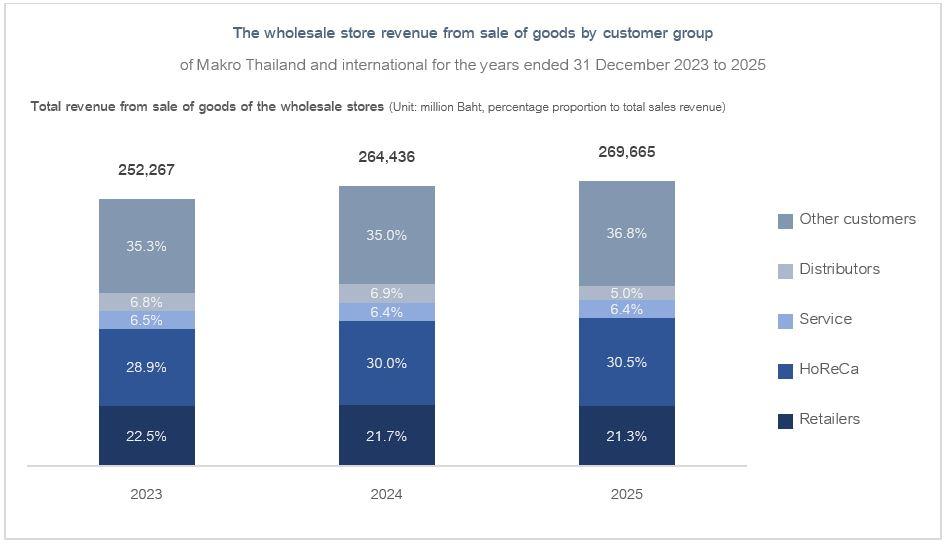
| Wholesale Business | The wholesale business is divided into the following two sub-business units: • Wholesale store operations in Thailand and overseas, under “Makro” and “LOTS Wholesale Solutions”, with exclusive rights to the registered trademark of CPALL, the major shareholder of the Company. As of 31 December 2025, The wholesale business focuses on the distribution of fresh food, dry goods, and non-food products, including both third-party brands and the Company’s private label products (“Private label”). Its three main target customer groups, namely HoReCa operators (“HoReCa”), retailers, and the end consumers (“Prosumer”). • Foodservice business focuses on the import, export, and distribution of premium food products, together with food solutions and delivery services. As of 31 December 2025, this business offers services in 8 countries and 25 cities, namely Thailand, Cambodia, Vietnam, Singapore, Hong Kong, the United Arab Emirates, Oman, and Malaysia. The Foodservice business specializes in sourcing and selecting exquisite products from high-quality sources, with For the year ended 31 December 2025, revenue from sales of goods of the wholesale business amounted to Wholesale Store Customers The majority of the customer base of the Company's wholesale store are professional entrepreneurs, mainly from small and medium-sized business-to-business (B2B) customers in various industrial sectors. The three main groups are as follows: • HoReCa – hotels, restaurants, and catering businesses, including small and medium-sized shops and street vendors providing a variety of food and beverages. • Retailers – consumer goods retailing operators, including grocery stores, local shops, and minimarts. • Service providers – service business operators in various sectors, including government agencies, service businesses, schools, hospitals, non-profit organizations, beauty parlors, printing, and laundromats, among other retail and In addition to the operator customer segments described above, the Company’s wholesale store also serves • Other customer segments – including consumers purchasing in bulk for large-scale cooking, large households, and value-conscious shoppers seeking quality products at accessible prices, as well as small B2B businesses, street vendors, and non-food retail shop owners. • Distributors – small and medium-sized independent regional wholesaling operators providing food-related products. The wholesale business serves both members and non-member customers. However, to strengthen customer loyalty and increase customer stickiness, the company places emphasis on promoting customer membership. Customers can register as a “Makro” membership through various channels, including nationwide stores and the online platform, called Makro Pro, which provides convenience and increases access to the company's products and services. For the year ended 31 December 2025, revenue from the sale of Makro Thailand and international amounted to
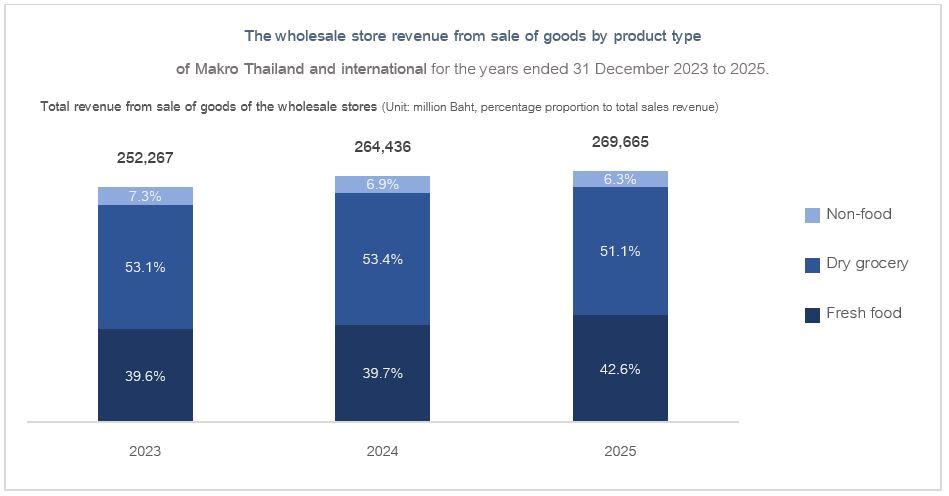
Wholesale Store Products The wholesale business provides a wide range of consumer goods in the following 3 main groups: • Fresh food – fresh, frozen, ready-to-cook, ready-to-eat, and chilled, including fruits and vegetables, meat, seafood, dairy products, and bakery items, among others. • Dry grocery – beverages, snacks, cleaning supplies, cosmetics, alcohol and tobacco, and personal care products, among others. • Non-food – electronics, appliances, kitchen equipment, tableware, furniture, office equipment, HoReCa-related products, food industry clothing, stationery, office supplies, home appliances, and household maintenance, The Company has prioritized fresh food products. In addition to products under the brand of other distributors, • Aro is the main brand for B2B products consisting of raw materials, cooking utensils, and consumer goods, as well as Aro Gold, which focuses on premium, organic, and high-quality products. • Savepak is an entry-level product brand. • Carne Meats, Ocean Gems, and Masterpiece are food brands under the Foodservice business unit, serving wholesale, retail, and HoReCa customers. Driven by the Company’s strategy to expand its private label portfolio and develop an exclusive brand in partnership with business partners, offering value-driven and differentiated products available exclusively through the Company’s distribution channels (“Exclusive brand”), private label sales increased to 18.6% of total sales of the wholesale business for the year ended 31 December 2025. The private label brands are owned by CPALL with a 0.5% royalty fee on For the year ended 31 December 2025, Makro Thailand and international had total sales revenue of Baht 269,665 million. The wholesale store revenue from sale of goods, categorized by product type, is comprised of fresh food,
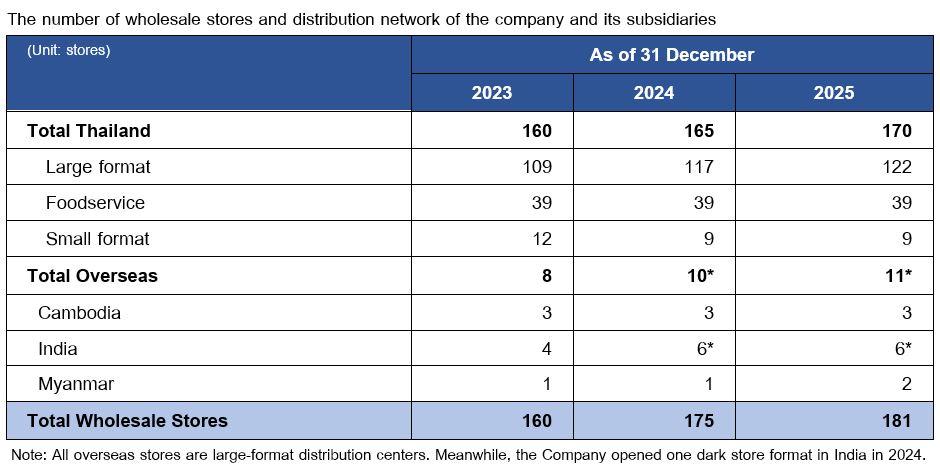
The product mix strategy focuses on driving growth in fresh food, ready-to-cook, and ready-to-eat categories to strengthen differentiation and maintain leadership in Thailand’s food retail market. This strategy is supported by expanding food selling space across stores, alongside enhancing supply chain capabilities to continuously support The Company and its subsidiaries focus on delivering targeted product offerings tailored to specific customer segments. For HoReCa customers, who typically prioritize product quality alongside value and accessible pricing, the Company develops integrated food solutions covering a full range of cooking ingredients and business-support products that enhance operational convenience, as well as competitively priced private label offerings. These include products designed to create added value and strengthen competitiveness for retailers. At the same time, the Company serves prosumer customers seeking value and differentiation by offering quality products at affordable price points, including exclusive brands that are available only through the Company’s distribution channels. In addition, the Company and its subsidiaries pursue a dry goods and non-food product strategy, focused on direct sourcing to enhance price competitiveness, while curating leading global brands at accessible prices to meet evolving customer demand. Wholesale Store Distribution Channels The wholesale business of the company and its subsidiaries sell products through “Makro” wholesale distribution centers, which serve as offline channels, as well as through online channels and Omni Channel sales, offering product delivery to customers. As of 31 December 2025, Wholesale store expanded to a total of 181 stores, with 170 locations in Thailand and 11 stores overseas. These operate in 3 different formats, varying in terms of target customer groups, sales space, location, and product mix. 1) Wholesale Store and Distribution Network Strategy The Company’s wholesale stores serve more than a traditional retail function. Each location is designed in line with • Large format stores – designed to serve the full spectrum of customer segments, with an average selling area The Company actively optimizes in-store SKUs assortment by prioritizing fast-moving products, while expanding assortment breadth on digital platforms to maximize operational efficiency. During the year, the Company continued upgrading store formats to align with evolving customer behavior by integrating retail space with warehousing and fulfillment areas to support Omni Channel sales, alongside developing commercial rental areas in strategic locations tailored to local demand and area potential. • Small format stores – comprising Food Shop and Siam frozen shop, focusing on fresh food, frozen food and selected dry food, enabling convenient access for customers without the need for long-distance travel, with a sales area of The number of wholesale stores of the company and its subsidiaries in Thailand and overseas, categorized by format and location as of 31 December 2023 to 2025, are as follows:
Optimizing the supply chain, distribution system, and logistics network are the main business strategy that allow Moreover, the Company has been improving and increasing its distribution capacity, by establishing a new distribution center of approximately 100,000 square meters in Wang Noi District, Ayutthaya Province (Central Region of Thailand). This distribution center supports integrated distribution of fresh food, dry food and e-commerce. Currently, approximately 60% of the new distribution center’s capacity is utilized. By early 2024, the Company launched an online fulfillment center - dry food commenced services to support After the amalgamation, the Company is studying how to enhance the efficiency and flexibility of logistics operations, such as utilizing the existing assets in full potential, as well as reducing the duplication of investment. This would efficiently develop the organization structure and create opportunities to obtain long-term return for the Company. 2) The Online Platform In today’s digital economy, the retail sector is undergoing a rapid transformation, driven by technological innovation, data-driven strategies, and evolving customer expectations. In 2025, Makro PRO continues to strengthen its position The Company continues to enhance and strengthen the platform to reinforce its market leadership, focusing on • Extensive assortment – Makro PRO manages one of the largest and most comprehensive online grocery assortments • Customer coverage – this breadth reinforces Makro PRO’s role as a one-stop platform serving professional customers, HoReCa operators, SMEs, and general consumers. • Market positioning – Makro PRO remains the top-of-mind grocery e-commerce platform, particularly among B2B and HoReCa customers, supported by its scale, credibility, and deep understanding of professional customer needs. • Customer-centric strategy – the platform continuously enhances the end-to-end customer journey, from product discovery and price transparency to fulfillment, delivery, and after-sales service. • Enhancement of application and digital interfaces – to improve key service touchpoints, including: - Efficiency of search and product discovery - Personalization and product recommendation systems - Faster checkout and flexible payment options - Real-time order tracking and service communications • Service innovation initiatives – designed to meet evolving customer needs, including the launch of Gold Container, • Major core technology infrastructure upgrade in 2025 – aimed at enhancing speed, accuracy, and operational scalability, while enabling advanced data and analytics to support merchandising, pricing, demand forecasting, and customer experience improvements. This includes upgrades to the Order Management System (OMS), Warehouse Management System (WMS), picker optimization systems, and Transportation Management System (TMS). Makro PRO views its 2025 achievements as a foundation for future growth. The Company plans to build on this momentum by expanding automation capabilities and leveraging data with AI-driven personalization to deliver more relevant customer offerings, developing digital tools to support B2B operators, strengthening platform partnerships and seller ecosystems, and continuously enhancing application performance and user experience. Makro PRO aims 3) B2B Sales Force and Operator Enablement Strategy The Company has developed a dedicated B2B sales team to ensure close engagement with business customers and B2B sales team is set up to facilitate and develop professional customers regularly to discuss products and services In 2026, the Company plans to further strengthen the sales team by continuously upgrading selling capabilities, developing the team into a “B2B Taokae Team” with a deep understanding of the operational models of each customer segment. The team is positioned as a trusted business advisor and partner (Solutions provider), capable of addressing customer pain points and specific needs, while delivering both products and services and providing efficient, integrated end-to-end business solutions. The Company plans to collaborate with business partners to develop our customers for sustainable growth under The Company believes sustainable development relies on steady progress and grows together in tandem with 1) Makro Retailer Alliance (“MRA”) supporting traditional trade operators For more than 17 years, the MRA program has upgrading the capabilities of over 500,000 retailer stores by providing business know-how, access to expert networks, and capability-building activities such as Makro Retailer Expo, Shohuay On-Tour, and in-depth seminars led by industry specialists. In 2025, Makro further enhanced traditional trade development under the “Mitr Tae Shohuay” initiative, partnering with over 3,000 stores and leveraging data analytics technology to improve store management efficiency. This has evolved into a seamless Makro ecosystem that supports entrepreneurs across three key dimensions: • Smart Order – AI-powered ordering recommendations based on historical sales data, focusing on high-margin products and promotional items, alongside inventory management systems. • Delivery – standardized logistics services with express delivery within three hours, ensuring product availability • Valuable Deal – exclusive benefits from Makro campaigns, Makro PRO Point rewards, and special promotional assortments available only to Mitr Tae Shohuay members. These services and business solutions help retailers’ owners to operate and manage their operations more easily, strengthen financial stability, and improve quality of life 2) Chef's Club by Makro sustainable food business growth community for HoReCa operators The Company and its subsidiaries are committed to strengthening the capabilities of HoReCa operators to achieve stable and sustainable growth. This is delivered through essential knowledge, technology, and innovation, as well as business networking platforms that elevate operational standards and food quality to international levels. • Skills and Capability Development – food innovation, menu planning, food safety, and cost control. • Smart Business & Digital Solutions – order management systems, digital payment solutions, efficient delivery services, and food waste reduction technologies. • Quality and Sustainability – accessibility to safe, traceable, and standards-compliant products to build consumer confidence. • Business Networking and Opportunity Expansion – hosting Makro HoReCa Events as platforms to showcase innovation and create business opportunities, including business matching activities and connections between operators, suppliers, and emerging consumption trends in the market. Wholesale Store Pricing Strategy The ability to set product prices at a competitive level for business operators and quality products at value-for-money prices for all consumer segments is one of wholesale store’s key advantages in maintaining its competitive advantage and position as the market leader. As such, the following pricing strategies are used by the Company: • Cost Control and Efficiency Enhancement – maintaining price leadership in the market and continuous improvement of organizational structure and supply chain efficiency. • Product and Packaging Development – differentiating product formats and packaging to reduce direct price competition. The adoption of shelf-ready display packaging helps streamline operations across the supply chain and lower operating costs for business customers. • Ongoing Price Competitiveness Monitoring – regular benchmarking of regional markets with regular price evaluation and adjusting pricing strategies in line with prevailing market conditions. • Strategic Supplier Partnerships – maintaining long-term relationships and cooperation with manufacturers and distributors, including direct sourcing without intermediaries and co-developing exclusive brands to offer differentiated products at attractive price points. |
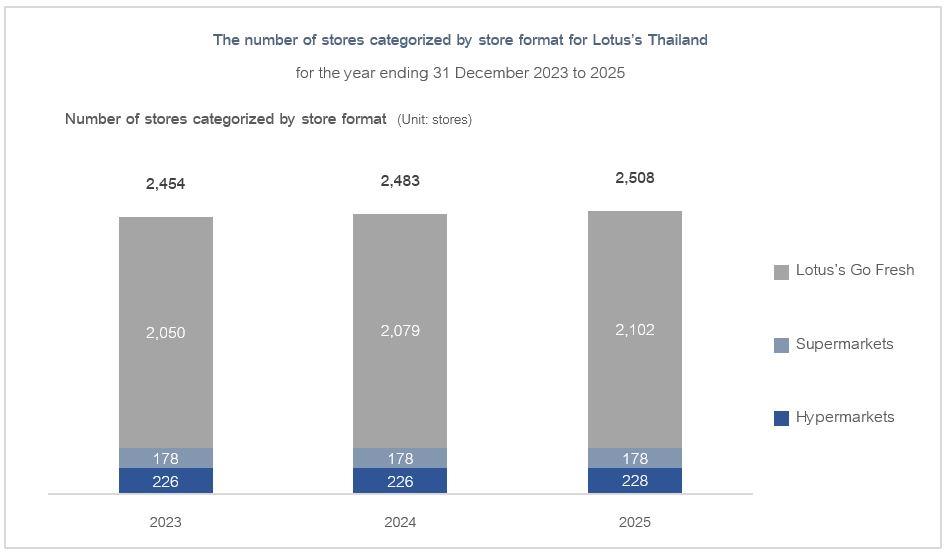
| Retail Business - Thailand | Retail Business Group The Company operates its retail business under the Lotus’s brand in Thailand and Malaysia. For the year ended Lotus’s Thailand Lotus's operates a retail business and manages rental space in shopping centers in Thailand under brand Lotus’s (“Lotus's Thailand”), which is the leading multi-channel retailer in Thailand, either store-space or market-share-wise. • Quality improvement of products and services at a cost-effective price • New store embellishment, decoration, and modernization, as well as applying new technological systems to optimize Lotus's Thailand business operations and boost customer convenience • Increase in branches to cover more areas in Thailand, with the expansion of both in-store and out-of-store sales channels. Focus on growing out-of-store sales channels and direct delivery to customers through the Lotus’s Thailand online distribution platform (Lotus’s SMART Application), offering both express and next-day delivery services to enhance customer convenience. The company leverages its network of 2,293 stores to support widespread product distribution while also expanding partnerships with leading online platforms such as Grab, Food panda, Shopee, Lazada, Lineman, and TikTok Shop to increase consumer’s distribution points • Moreover, the core business is strengthened by expanding into related businesses such as coffee and cafe chains Retail Store Network Strategy of Lotus’s in Thailand Overview of Retail Store Formats in Thailand Lotus’s Thailand operates its retail business through three store formats: Hypermarkets (H-Store), Go Fresh supermarkets, and Lotus’s Go Fresh • Lotus's hypermarket – large retail store with a one-stop shopping complex, which normally has sales area of about 2,000 to 8,000 square meters. Lotus’s Thailand is one of the leading hypermarket networks in Thailand. H-Stores focus on fresh food and dry food, including health and beauty products, household and baby products, home appliances, and clothing, among others. H-Stores provide various services to meet customers' needs, such as top-up, bulk, or stock-up purchases for later use. H-store is key to the online distribution integration project as a multi fulfillment hub and • Go Fresh Supermarkets – medium-size retail store with a sales area between 500 and 1,500 square meters, serving mostly in commercial or suburban areas under the neighborhood store concept for regular and convenient close-range drive and foot shopping with a focus on the distribution of quality fresh and dry food products, including various consumer products, especially in health and beauty, household goods, and baby products. Customer needs for either top-up additional items or stock-up for later use can be satisfied at Go Fresh. This mid-size retailer also plays a key role • Lotus’s Go Fresh – small retail store with a sales area ranging from 150 to 450 square meters. As one of the largest mini-supermarket operators in Thailand, Lotus’s Thailand has positioned Lotus’s Go Fresh as a key driver for the future growth of its retail business in the country. Currently, Lotus’s Thailand operates Lotus’s Go Fresh stores in various residential and commercial areas, including petrol stations, to offer convenience and easy access for customers. As of 31 December 2025, Lotus's in Thailand had a total of 2,508 stores, consisting of 228 hypermarkets,
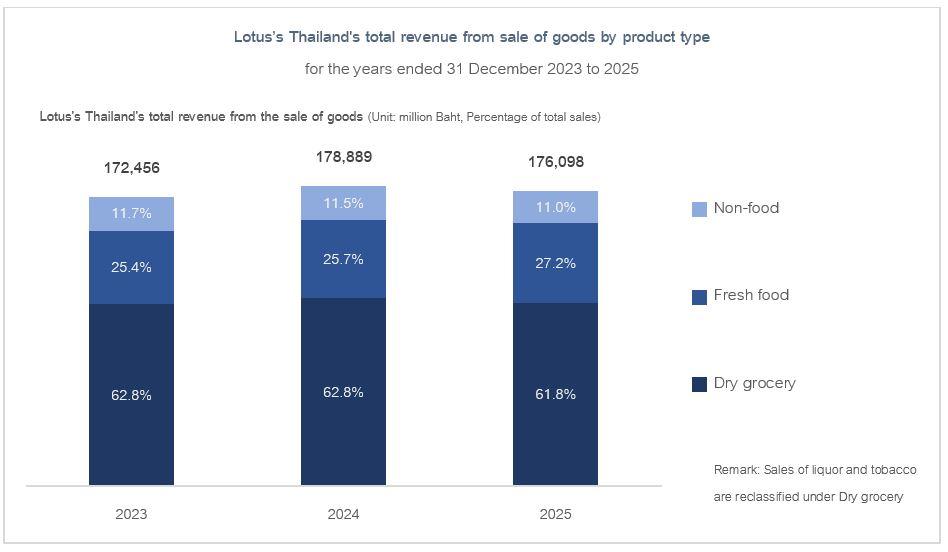
Online channels and out-of-store sales with customer delivery services ("Omni Channel") In addition to brick-and-mortar retail operations, Lotus's Thailand serves online customers nationwide by leveraging SMART features on the Lotus’s SMART Application enhance the online shopping experience with over 30,000 products covering all categories, such as fresh food, dry food, beverages, home appliances, mother-and-child products, Key Developments for the Retail Business in Thailand The Company is committed to developing and expanding the retail business in Thailand by implementing the following new initiatives: • Reinforcing its position as a comprehensive food destination – through designing customer experiences that combine convenience, speed, and enjoyment, by developing ready-to-eat corners within stores so that customers can immediately experience and taste the quality and flavor of CP Axtra products at the point of sale. This helps enhance brand value perception, stimulate purchase decisions, and significantly increase visit frequency. • Strengthening online channels and digital platforms – as a key driver of long-term growth, by enhancing user experience to create enjoyment and continuous engagement through the design of missions, activities, and campaigns within the application to encourage repeat usage, build customer engagement, and further utilize data insights • Strengthening online sales channels – by continuously expanding the new customer base through customer acquisition programs, together with collaboration with the loyalty team to create campaigns that drive engagement and increase sales. In addition, the Company utilizes customer data analytics to develop and enhance personalized marketing strategies to improve customer experience and more effectively meet the needs of each customer segment. • Renovating and upgrading store formats – by modernizing stores and aligning them with the identity of each community through improvements in store design, decoration, and equipment, including store layout arrangement and enhancing the prominence of each product zone to improve merchandising efficiency, alongside creating a shopping atmosphere that encourages longer time spent in-store and product discovery. • Continuously enhancing in-store shopping experience to be engaging and differentiated – through in-store activities and curated assortments in health, beauty, and lifestyle categories aligned with modern consumer behavior, • Maximizing the potential of existing assets – including new-concept restaurants, experiential spaces, community spaces, and wellness service areas, as well as selecting distinctive brands in health, beauty, technology, and fashion categories, aiming to become a ‘Happy Mall’ that responds to diverse lifestyles and creates a comprehensive and impressive experience. • Launching a new space management concept under the OASIS brand – as a center of happiness for the community by developing areas in residential locations into relaxation spaces and food hubs that meet local needs, together with stores and services that support daily lifestyles for all generations. • Expanding store coverage – as traditional retail stores had a high penetration rate across the country, even in areas without a physical store, Lotus’s Thailand plans to open new stores in uncharted territories to make Lotus's stores more accessible to expanded customer bases to better serve and meet their needs. According to the new store expansion plan, Lotus’s Thailand aims to open 3 new hypermarkets, 4 new supermarkets, and 100 new Lotus’s • Enhancing convenience of online ordering through express delivery services – Lotus’s Thailand has upgraded services on the Lotus’s SMART App platform by leveraging its store network as store-based fulfillment hubs to increase delivery speed and efficiency due to proximity to customers’ residences. Customers can choose on-demand delivery The commitment to business development to meet the smart shopping needs of modern customers and to create positive everyday experiences at Lotus’s led to Lotus’s receiving prestigious recognition at the Retail Asia Awards 2025, reflecting marketing success in understanding Thai consumers by integrating cultural perspectives with retail innovation. This transformed traditional promotional activities into campaigns that generated strong commercial results. Lotus’s received three awards, namely Domestic Retailer of the Year – Thailand, Hypermarket of the Year – Thailand, and Influencer Marketing Campaign of the Year - Thailand, as well as recognition from Marketeer No.1 Brand Thailand 2025 as the ‘No.1 Most Popular Brand in the Retail/Modern Trade Wholesale Category.’ Retail Product Mix in Thailand The key factor in the success of the retail business in Thailand is the offering of a wide variety of products in Lotus’s Thailand stores. The main product categories sold by Lotus’s Thailand are fresh food, dry groceries, and non-food items. Lotus’s Thailand sells these product categories under leading brands both domestically and internationally, including small and medium-size enterprises (SME) as well as Lotus's private label products, and various exclusive brands. The details are as follows: • Fresh food – includes meat, seafood, fruits and vegetables, dairy products, eggs, ready-to-cook, ready-to-eat, bakery items, and frozen food. In addition, Lotus’s Thailand has developed a range of value-added products such as grilled chicken, ready-to-cook and ready-to-eat meat, as well as product innovations like plant-based meat. Fresh food is the key and fastest growing product category for Lotus’s Thailand. - Dry Food Consumer Goods – includes cooking products, beverages, dry foods, pasteurized milk, and plant-based milk, infant products, confectioneries, dietary supplements, canned foods, and baking machines. These consumables are carefully curated with a wide range of price levels, various brands, including imports. - Non-durable Fast-moving Consumer Goods – includes health and beauty items, household goods, baby products, and pet products. These non-durable goods are carefully curated with a wide range of price levels, various brands, and imports. - Liquor and Tobacco – includes beer, wine, and spirits, as well as a wide range of both locally produced and imported tobacco products for each store format. • Non-food – includes household appliances and products, e.g., toys, stationeries, sports equipment, bathroom and bedroom products and accessories, furniture, bags and suitcases, plastic storage boxes, kitchen utensils, auto accessories, electronics, and home improvement DIY products that require self-assembly and installation. Lotus's Thailand also focused on offering a wide range of kitchen and food preparation products to leverage its hallmark as the nation's leading food distributor and optimize in-store sales spaces for the changed consumer behavior and food trends. For electronics, Lotus's Thailand offers both large and small appliances, and also collaborates with the CP Group on co-marketing campaigns to offer products in the electronics section, namely mobile phones, SIM cards, and internet-connected home goods, such as smart bulbs, power sockets, and thermostats, along with electronics accessories, and have a joint effort to develop online telehealth consultation services where customers can seek doctor consultation online at the store. - Apparel – clothing products include everyday wear, with a focus on essential comforts for all family members. In addition to offering products under leading brand manufacturers, Lotus's Thailand offers over 5,000 private-label products across all product categories under the Company's trademark (Private label) as an alternative for customers, aiming to differentiate and add value to the products in the 2 following groups: • Lotus's is a Lotus’s Thailand core brand, offering various groups of high-quality products, which the quality exceeds the price. • Value is a an entry-level brand for everyday life-essential brands, providing an alternative at very cost-effective prices, as well as a brand for daily essentials at the lowest price every day. Moreover, Lotus's Thailand continuously develops private label merchandises, such as Momento for home goods, Aliv for health and beauty products, NaxNax for snacks, Cute & Care for mother and baby products, Soft Care, Clean Action, and Plus Wash brands for household cleaning products, Pet Us brand for pet products, and MeStyle for clothing products. For the year ended 31 December 2025, Lotus's retail business in Thailand had total sales revenue from the sale of goods amounting to Baht 176,098 million. The sales revenue from the wholesale store business, categorized by product type, consists of consumer goods, fresh food, and general merchandise, accounting for 61.8%, 27.2%, and 11.0% of total sales revenue in Thailand, respectively. The retail sales revenue by product type for Lotus’s Thailand for the years ended 31 December 2023 to 2025, are as follows:
Retail Customers in Thailand The retail customer segments in Thailand vary by age, income, and household size ranges. The key strengths of Lotus's Thailand in attracting customers include: • The attitude of customers toward Lotus's Thailand products as value for money. • Lotus's Thailand dedication to customer service and involvement in the local community that focuses on sustainability for communities. • Lotus’s Thailand plans to leverage these advantages to reach an expansive base of customers, especially those in Lotus’s Thailand analyzed in-depth customer data to provide a deeper understanding of Lotus’s Thailand customers and thus an opportunity to create a satisfying shopping experience, bring in new and retain existing customers, and curate suitable products for each group. The analytics also brings to light purchasing behavior, enabling Lotus’s to study the underlying shopping motives, develop pricing strategies and promotions that add value to the engagement with Lotus’s, and accurately predict future shopping behavior. The My Lotus's Thailand membership program is introduced to build and maintain hard-earned customer relationships and enable customers to collect points for their purchases at Lotus's stores. The data analysis suggests that My Lotus's Thailand members are more likely to shop than non-members, either by total purchase value or individual purchase volume. As of 31 December 2025, Lotus's Thailand had approximately 22 million My Lotus's members. Retail Distribution and Logistics Network of Lotus’s Thailand A key factor in Lotus's retail strategy is the optimization of the supply chain and the distribution and logistics network, which allows Lotus's to optimize inventory levels across stores and distribution centers in a way that is efficient and suitable for products with a short shelf life to remain fresh and maintain the highest quality, enabling Lotus's to offer value-for-money to its customers continuously. The distribution center of the Company has adopted modern logistics machines and systems such as a semi-automatic light-based product picking system (Pick-to-light system), and automatic product sorting machine (Sortation system), The Company continues to focus on improving the efficiency of its distribution system and logistics network, such as implementing the "Hub & Spoke" distribution system for large electrical appliances. This system designates certain hypermarket stores as storage and delivery hubs, ready for installation at customers' homes. In June 2024, As of 31 December 2025, the Company had 7 distribution centers for its retail business, with a total building area of approximately 297,100 square meters. This area includes 2 online fulfillment centers with a combined area of approximately 16,900 square meters. Lotus's Shopping Center in Thailand The shopping center consists of property management and operation of Lotus's Thailand shopping centers and retail stores, as well as acting as the property manager of the shopping centers that the Axtra Future City Freehold and Leasehold Real Estate Investment Trust (“the Trust” or “AXTRART”), a fund of which holds 25% of investment units. As of 31 December 2025, Lotus's shopping center business in Thailand has the following details. • Leasing space management in 206 shopping centers (excluding the 23 shopping centers invested by AXTRART as detailed below), with a permanent NLA of approximately 799,979 square meters with Lotus's Thailand hypermarkets as the flagship store, whereby the Company is the freehold land-and-building owner of 64 shopping centers, accounted for about 31% of all shopping centers under brand Lotus’s. • As of 31 December 2025, the Company holds 25% of trust units, which is the largest unitholder. • In addition, the Company has entered into agreements to act as property manager for 23 Lotus’s shopping centers under the Trust, with total permanent NLA of 334,036 square meters. Lotus’s Shopping Center Mix in Thailand Lotus's shopping center lease management business in Thailand, excluding duties as the AXTRART property manager, manages lease spaces in the following 3 types of shopping centers to serve various groups of customers: • Family malls – large shopping centers for families with various shopping services and entertainment activities, focus on particular business lessees, namely restaurants, fashion boutiques, financial service providers, and lessees providing entertainment-related activities, among other service providers. It typically has a permanent NLA of over 5,000 square meters. • Neighborhood malls – medium-size stores, where customers can swing by in the community for a quick and easy grab, especially food products. It typically has lease spaces for a variety of restaurants, beverage shops, and grab & go-fast food outlets. Although the lease spaces are smaller than Family Malls, in-store shops are available for family entertainment activities and fashion boutiques, along with financial and other service providers. The malls typically have a permanent NLA between 2,000 and 5,000 square meters • Service malls – smaller malls providing one-stop-shop spaces. The smallest of the three formats focuses on everyday products, necessities, and services, alongside selected restaurants, clothing shops, and children's play areas, among other services provided. It typically has a permanent NLA of up to 2,000 square meters. The Company’s shopping centers sit in suitable locations throughout Thailand to serve in strategic areas that reach as many customers as possible, mostly in the central Bangkok metro area as well as other regions in the metropolis, each having a hypermarket under brand Lotus’s as the flagship attraction. Shopping Center Leasing Projects Lotus's Thailand continues to select suitable locations for new shopping centers across Thailand using the following criteria: • Area with a large and dense population. • Prominent locations with the potential of increasing in-store foot traffic. • Access to main roads, public transit system, large parking areas and sound infrastructure Lotus's Thailand has several projects related to shopping center leasing as follows: • Future shopping center development projects – developing rental spaces into community shopping centers for • Optimizing shopping center space layouts plans – utilizing underused spaces, and seamless hypermarket-leased • Maximizing space utilization – increasing the proportion of food-related commercial space, balancing mass market, niche market, and traditional food brands, and transforming shopping centers into food destinations, maximizing customer foot traffic volume and rate for in-demand shopping center leases in the process. • Optimizing food courts – improving formats, space, and tenants to suit customers in each location. Lotus’s has renovated and segmented food court areas into three main formats to respond to different consumer lifestyles, - Lotus’s Eatery – a newly upgraded food court format with a more modern and stylish concept, designed to - Lotus’s Eats – an improved format focusing on convenience and value for money, selecting popular restaurants familiar to consumers and offering them at accessible prices. The key feature of this format is flexible and fast space management, suitable for customers who want to save time while maintaining standard taste and cleanliness, making - Lotus’s Food Court – a traditional standard food court format focusing on quick-service meals with a variety of basic menu options, with the main objective of providing customers with a simple, fast, and affordable dining option under reliable standards. • Digital experience optimization – incorporating and implementing new IT infrastructures and applications to support digital payments and create shopping satisfaction. • In-store shop mix optimization – managing the appropriate proportions of suitable shopping center lessees by selecting and attracting restaurant operators and other quality service providers, focusing on branded or widely known franchises, and presenting a new shopping center atmosphere and image with the best in-store shop mix variety. • Health and beauty optimization – improving health and beauty services by allocating space for health and beauty Investment and provision of services to Axtra Future City Freehold and Leasehold Real Estate Investment Trust The Company holds 25% of AXTRART, which was the largest unitholder of AXTRART, the Real Estate Investment Trust listed on the Stock Exchange of Thailand. AXTRART owns 23 shopping centers under the Lotus's brand across Thailand and one Life Xpress new-format convenience store project. In addition, the Company has entered into an agreement to act as the property manager of the Trust to manage
Shopping Center Tenants Mix in Thailand Lotus's Thailand has several types of tenants in Lotus's shopping centers in Thailand. The three main tenants • Permanent lessees – 1-year or longer tenants with either a fixed monthly lease payment or variable lease rate according to sales performance, with or without a minimum lease guarantee, including hypermarket and other lessees As the source of revenue stream, permanent lessees, namely the largest group of tenants in Hypermarkets, are integral to Lotus's Thailand shopping center leasing business success, averaging a lease term of about 3 years with major tenant lease commitments as long as 30 years. Financial, hospitality, technology-related, food, clothing, beauty, and entertainment service providers are Lotus's Thailand permanent occupied NLA. • Temporary lessees – 1-year or shorter leases that set up shop as stands or small vendors with a high turnover rate, allowing Lotus’s Thailand to tailor new products and services to customers. • Food court lessees – Lotus's Thailand services contracts with food court operators in shopping centers for an average term of one year. Food courts help attract foot traffic to shopping centers and other in-store lessees as customers prefer the price, quality, and quantity that offer a good value there. In addition to revenue streams from lessees, Lotus's shopping center leasing business in Thailand includes other sources of income from service charges, such as utility bills and land-and-building taxes, pylon signage leasing fees, property management fees from managing AXTRART-invested shopping centers, among others. |
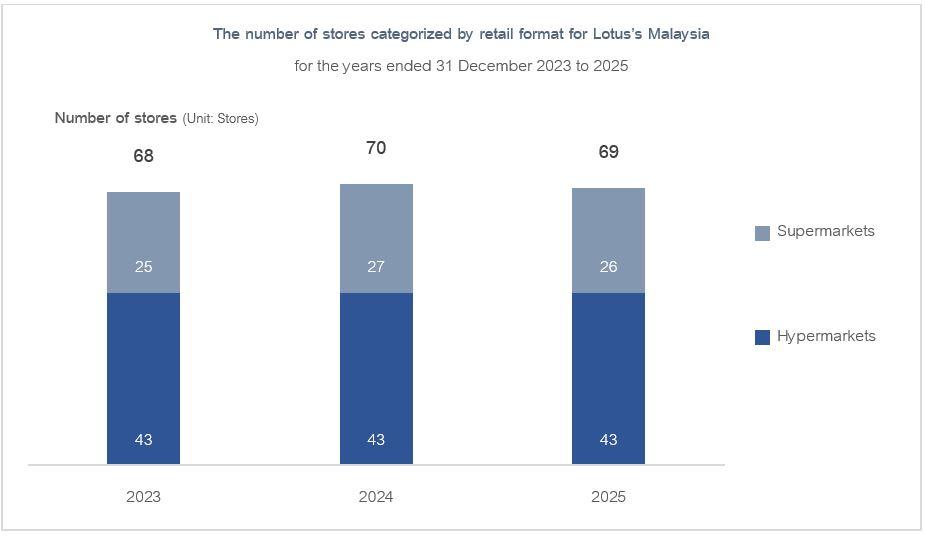
| Retail Business - Oversea | Lotus’s Malaysia Lotus's Malaysia's is a leading retail and shopping center business through its subsidiary, Lotus's Malaysia, the leading retailer in Peninsula Malaysia. As of 31 December 2025, Lotus's Malaysia had 69 retail stores located primarily in the Northwest, Central, and Southwest of Peninsula Malaysia, with as many as 24 stores in Klang Valley, Kuala Lumpur, the capital of Malaysia. Lotus’s Malaysia is supported by a reliable supply chain, an efficient distribution and logistics network, the strength of the Lotus’s brand, and planned investments in key strategic initiatives, which include: • Attract new customer segments with modernized Lotus's rebranding • Enhance the quality of goods and services with cost-effective offerings • Accelerate online sales growth by leveraging a network of over 13 stores, including improving efficiency and collaborating with leading online platforms such as Food Panda, Grab, Lazada, and Shopee to increase point-of-sale products for consumers • Leverage the wholesaling group know-how to expand and optimize distribution channels for B2B customers across the country, focusing on independent restaurants, traditional retail stores, and other local businesses such as hospitals, hotels, and schools Retail Store Network Strategy of Lotus’s in Malaysia Overview of Retail Store Formats in Malaysia Lotus’s in Malaysia operates retail stores through two store formats, with details as follows: • Hypermarket – Lotus's Malaysia hypermarkets are large retailers in Malaysia with a one-stop shopping complex focusing on fresh food and consumer products with a sales area between 4,000 to 7,000 square meters and an average sales area of about 5,200 square meters. • Supermarket – Lotus's Supermarkets are medium-size retailers under the Corner Store concept with a sales space between 1,000 to 4,000 square meters, located primarily in Peninsula Malaysia as a convenient choice for daily groceries and other goods. Regarding to its store network strategy, the Company is optimizing store formats and sizes to align with changing consumer behavior, as shoppers increasingly favor smaller retail formats. The Company is expanding more agile store models designed to enhance convenience and community accessibility. As of 31 December 2025, Lotus’s Malaysia
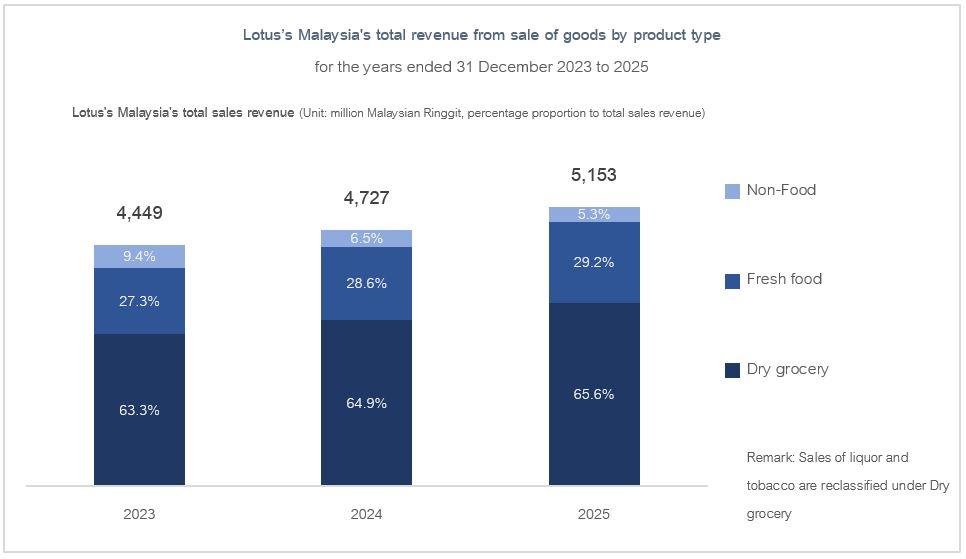
Online Channels. Alongside Lotus's Malaysia's offline brick-and-mortar retail outlets is Lotus's Malaysia online channel and services through the online shopping and other third-party online service providers such as Lazada, Grab, Food Panda, and Shopee. Lotus’s Malaysia has various methods to improve online customer satisfaction as follows: • Delivery online services that create greater customer satisfaction through Lotus's continuous IT improvement program, smart promotion, and presentation of enhanced alternative products. • Develop an online service center prototype, enabling more online services with optimized efficiency and lower operating costs. • Increase the number of stores in Malaysia that are able to provide online services through Lotus’s online shopping system, which is currently available in 13 stores. Key Developments for the Retail Business in Malaysia The Company aims to improve and expand the retail business in Malaysia with the following initiatives: • Enhancing the fresh food category as the key point of differentiation of the business – this is to support sustainable customer base expansion and strengthen profit margins, the Company focuses on developing fresh food as a structural advantage through upgrading product standards and quality control, developing personnel skills, increasing the proportion of direct sourcing and imports, as well as investing in production and packaging centers for meat, bakery, and fresh food products to maintain standards, control costs, and strengthen supply chain stability. • Store modernization – 8 Lotus's Malaysia stores have been modernized to better accommodate the changing needs • Accelerating B2B expansion – alongside the enhancement of offline brick-and-mortar is optimizing service capacities for B2B operators as a one-stop-shop destination for restaurant operators and local grocery chains regularly in need • Cost of sales and expense management – Lotus’s Malaysia continues to strengthen cost discipline through targeted operational initiatives. Localized fresh product ordering and improved demand forecasting have reduced spoilage and waste while enhancing product freshness. Technology-enabled loss prevention measures and tighter inventory controls have lowered shrinkage. Higher distribution volumes have improved fixed-cost absorption across the network, reducing unit logistics costs. In addition, the Company invests in solar energy to manage energy expenses. Retail Product Mix in Malaysia Providing one-stop-shop destinations with wide-ranging, affordable, and high-quality product mixes, namely fresh food, general goods, or clothing under various brands and private labels, among other consumer goods, is the core competency that determines Lotus's retail success in Malaysia. The retail product mix in Malaysia is as follows: • Fresh food – includes fresh fruits and vegetables, meat and seafood, and bakery products, as well as value-added items such as ready-to-cook food and ready-to-eat meals. Fresh food is a fast-growing product segment that effectively boosts foot traffic to the store. • Dry groceries – consumer goods include commodities, dry food, canned food, cooking and baking products, • Non- food – general merchandise includes a wide range of durable household goods, including home furnishings and accessories, electronics and computer accessories, outdoor entertainment, bags, home improvement items, - Apparel - Lotus’s Malaysia plans to expand its product categories into men's and children's wear, as well as festive apparels i.e., Chinese New Year, Back to School and Hari Raya. Under its trademark, Lotus's private label products are offered to provide shopping alternatives to customers where the product groups with large markets, high growth potential, brand variety in the market, and the best chance to stand out in the respected are selected for private label development under its trademark. Lotus’s has engaged local external manufacturers to produce products under its own trademark, while retaining the intellectual property rights of The Company plans to strengthen the quality of Lotus' products in the retail market in Thailand and Malaysia, including health food and other health-related products to focus on attracting more health-conscious consumers with wellness-oriented lifestyles. The Company plans to combine its product strategy for Lotus's Malaysia with its retail business in Thailand to allow cross-market distribution of Lotus's private labels and common sourcing to harmonize and synergize product mixes in Thailand and Malaysia with cross-market capacities without compromising the specific needs of each. For the year ended 31 December 2025, Lotus’s Malaysia had total sales revenue of 5,153 million Malaysian Ringgit.
Retail’s customer Malaysia Lotus's retail customers in Malaysia vary by age, income, and household size. To grasp consumption patterns, Lotus's has partnered with an established company providing professional customer segmentation and analytical services to conduct measurable studies of each customer segment and develop product strategies, plan product sales through both online and in-store channels, develop a loyalty program, and an effective marketing plan. To build and maintain customer relationships, the My Lotus’s program is presented to enable customers to collect points from their purchases from Lotus’s outlets. As of 31 December 2025, Lotus's Malaysia reported about 4.6 million members. In addition, My Lotus’s mobile application is also available, providing members with information, The Distribution and Logistics Network in Malaysia Strategic to Lotus's success in Malaysia is the supply chain distribution and logistics network optimization for maximum efficiency and effectiveness in managing appropriate inventory levels in Lotus's Malaysia stores across the peninsular. This is also necessary for maintaining the freshness of produce, deli, and fresh food through the journey from sourcing to Lotus's Malaysia shelves with the highest quality and offering value-added products to customers at a suitable price. As of 31 December 2025, Lotus's Malaysia owned 2 distribution centers and leased 1 distribution center for frozen products across the country, with about 89,243 square meters. Lotus's Malaysia operates with 3 different types of distribution centers: distribution center for storing consumer goods and general merchandise at room temperature, and a fresh food distribution center. Lotus’s Malaysia mostly operates its own distribution and logistics network in Malaysia. The network was comprised of Lotus’s Malaysia also provides distribution and logistics services for manufacturers and distributors in Malaysia to promote Lotus's online channels, including handling services such as freight, returns, and trades through cross-docking centers and transportation systems. Shopping Center Business in Malaysia As of 31 December 2025, Lotus's Malaysia shopping center business comprised: • Management of leased space in 63 shopping centers, with about 328,970 square meters of average permanent NLA
Lotus's shopping center in Malaysia Lotus's Malaysia manages three types of shopping centers in Malaysia to serve the following customer groups: • Family Malls – large shopping centers that target families and households with a permanent NLA of over 6,000 square meters where a range of shopping and entertainment activities are offered by the main lessees, namely restaurants, fashion boutiques, financial service providers, and entertainment event organizers, among others. • Neighborhood Malls – medium-size shopping centers with a permanent NLA between 3,000 and 6,000 square meters for customers to swing by for quick grab-and-go, especially food items, from wide-ranging restaurants, beverage shops, and fast-food eateries. Although smaller than Family Malls, there are also shops providing family entertainment activities, fashion boutiques, as well as financial and other services. • Service Malls – smaller shopping centers with a permanent NLA of up to 3,000 square meters serving as a one-stop shopping destination for daily products and services, along with restaurants, clothing shops, and service shops for various daily needs and playground areas for children. Lotus's Malaysia regularly evaluates and selects shopping center locations in strategic areas across Peninsular Malaysia to maximize access and consumer reach with a hypermarket as the main lessee in the establishment. The assessment criteria for selecting new locations are as follows: • An area with a large and dense population • A prominent location with increasing in-store customer foot traffic • Access to main roads and public transit systems • A large parking area with a sound infrastructure system Shopping Center Tenants Mix in Malaysia There are three main groups of Lotus's Malaysia shopping center tenants: • Permanent tenants – under minimum lease period of at least 1 year or longer with fixed or variable lease rates based on sales performance, with or without minimum payment requirements. Where the average lease term is approximately 2 years, major tenants have an average term of 3 years. Together, they contribute to the success of Lotus's shopping center leasing business in Malaysia as a source of a stable income stream, including tenants in various businesses such as food-beverage, health-beauty, DIY, and clothing, entertainment, and sporting goods, among other service providers. • Temporary tenants – under one-year leases that set up stalls or small shops and have a high turnover rate, allowing Lotus's Malaysia to tailor new products and services to changing consumer behavior. • Food Court – Lotus's Malaysia has lease contracts with food court service operators in Lotus's shopping centers |

Research & Development
Has R&D Policy (Y/N)
Yes
R&D Cost — Description
R&D expenses over these three years reflect the commitment to strengthening technological capabilities in digital platforms and advanced IT infrastructure that can swiftly and efficiently meet customer needs, support sustainable growth, and secure long-term competitive advantages.
R&D Cost — Label
Research and development (R&D) expenses over the past 3 years (Million Baht)
R&D Cost — This Year
1512.0
R&D Cost — Last Year
1451.0
R&D Cost — 2 Years Ago
1821.0
Assets Used in the Business
Permanent Assets — Description
Significant fixed assets of the Company and its subsidiaries as of 31 December 2023, 2024, and 2025 consist of:
• Investment properties amounted to Baht 44,314 million, Baht 56,463 million, and Baht 59,686 million respectively.
• Property, plant and equipment amounted to Baht 115,574 million, Baht 117,695 million, and Baht 124,285 million respectively.
• Right-of-use assets amounted to Baht 39,751 million, Baht 41,079 million, and Baht 48,105 million respectively.
- Please consider in detail Attachment 4 "Business Assets and Appraisal Details".
Intangible Assets — Description
Significant intangible assets of the Company and its subsidiaries as of 31 December 2023, 2024, and 2025 amounted to Baht 10,983 million, Baht 10,831 million, and Baht 12,104 million respectively. These mainly consist of computer programs, trademarks, and other assets.
- Please consider in detail Attachment 4 "Business Assets and Appraisal Details"
Trademarks and service marks
The Company and its subsidiaries held trademarks valued at Baht 462 million, Baht 460 million, and Baht 848 million
as of 31 December 2023, 2024, and 2025, respectively.
- Please consider in detail Attachment 4 "Business Assets and Appraisal Details"
Has Subsidiaries Investment Policy (Y/N)
Yes
Subsidiaries Investment Policy — Description
The Company's policy is to invest in potential subsidiaries and associated companies with similar vision and growth plans that synergize operational capacities or optimize its operating results or competitiveness as a Group in attaining set goals as a leading operator in the business.
The Company, its subsidiaries, or associated companies, or all, may consider investing in other businesses under
the same conditions. In considering such investment, the Company evaluates investment proportions, calculated risks and return, financial status, as well as investment feasibility and potential. The approval by the Executive Committee
or the Board of Directors or the Company's shareholders' meeting is required, or by more than one of the approving parties as the case may be, under the Notifications of the Capital Market Supervisory Board and relevant SEC notifications.
Marketing Policy & Competition
Reporting Mode
3117
Marketing Policy (Overall)
The Company's marketing campaigns are planned on a national scale and implemented locally. CPAXT's fundamental marketing strategy concerns realigning traditional marketing through digital online channels while highlighting
high-quality products at better value for target customers through various distribution channels.
For the wholesale business, the Company implements strategies to promote the Company’s brand and private label products through integrated offline and online communication channels in order to effectively reach all customer groups. The Company enhances brand visibility and awareness through product catalogs and targeted promotions, communicated via Makro mail, HoReCa mail, and targeted digital channels, enabling customers to compare prices,
plan purchases, and create profit opportunities more easily. In addition, the Company also offers good quality products at worthwhile prices and “Buy more save more” promotions to meet the needs of customers in all groups, together with providing hands-on experience from in-store product demonstrations to help enhance understanding and stimulate purchase decisions.
In order to expand access to customers of all generations, the Company communicates marketing activities through
the Makro PRO application and various social media platforms to help increase convenience in timely ordering,
together with expanding and retaining the customer base through membership programs and delivery services
that respond to the lifestyle and behavior of modern consumers. The Company has specialized teams that work collaboratively to effectively implement targeted marketing plans, consisting of:
• Insight Team – monitoring store performance and analyzing customer behavior to identify strategic opportunities.
• Proposition Team – developing marketing plans based on customer data and needs, together with driving key growth factors.
• Communication Team – translating strategies into Omni Channel communication that attracts and engages customers.
• Social Commerce Group – using TikTok and Facebook to expand reach, increase purchase rates, and build brand preference.
With a data-driven and systematically collaborative operating model, the Company and its subsidiaries are confident that all marketing activities will enhance customer loyalty, drive sales efficiency, and support sustainable growth.
Lotus's retail business aims to provide customers with a one-stop-shop destination with convenient, swift, and proficient services through offline and online channels for all-encompassing needs, especially high-quality fresh food for value. Consistency in enhancing value and quality is fundamental to maintaining long-term customer relationships and thus Lotus’s success. To account for rapid changes in customer behavior and shopping preferences following the pandemic, increasingly turning to shop at stores in the neighborhood and using online delivery services, Lotus's has adjusted
its marketing activities as follows:
• Promoting enhanced customer services through online channels
• Promoting in-store shopping to increase shopping frequency
• Promoting per-shop volume to increase basket sizes
In addition, Lotus's offers other marketing programs to reach new customers and retain the existing base with
new-customer referral campaigns through various partner platforms such as restaurant service providers, food aggregators, e-commerce platforms and marketplaces, telecommunication service partners, and entertainment platforms. This includes new-customer welcome packs, personalized offers, exclusive customer rewards, and personalized customer communication to strengthen customer loyalty.
Lotus's is expanding its promotional and marketing campaigns of store trademarks and product brands to different customer segments, nationally and locally, through interviews with key thought leaders, online influencers, and business partners via social media as the target medium, as well as television and target local press, along with
product demonstrations and in-store events.
Lotus's has several teams dedicated to marketing, namely the insight team responsible for tracking and analyzing customer data to optimize marketing, the corporate and category team responsible for formulating marketing strategies using in-depth analysis, and the communication executing strategy provided by the proposition team. Additionally, Lotus's also applies customer data to personalize its products to individual customers by adjusting pricing and promotions accordingly.
Industry & Competition (Overall)
Industry Overview
The global economy in 2026 is expected to expand at a stable level, supported mainly by accelerated investment in technology, particularly artificial intelligence (“AI”), as well as fiscal policies that continue to play an important role in stimulating the economy in many countries, and global financial conditions that remain accommodative. However, uncertainties in trade and geopolitics affecting trade policies in many countries remain volatile and may impact global trade and investment conditions. In Asia, although growth has slowed from the previous year, it continues to be driven by the technology cycle and public spending. Meanwhile, Thailand’s economy is expected to expand by only 2.0%
due to external pressures and high domestic debt levels. Nevertheless, tourism and public consumption remain key supporting factors. For the retail business, overall sales are expected to recover, supporting demand for essential consumer goods in line with consumer behavior that focuses on necessities, value-for-money products, and
health-related products. The rental space business is expected to gradually expand in line with the gradual recovery
of the economy and the number of tourist arrivals.
According to the report of the International Monetary Fund (“IMF”) in January 2026, the global economy is projected
to continue expanding at 3.3%, a rate close to the estimate for 2025, with key support from accelerated investment in technology, particularly in North America and Asia, which helps offset the impact of the slowdown in global trade volume following adjustments in trade policies. Global inflation is expected to continue declining to 3.8% in 2026
due to weaker demand and lower energy prices. For major economies, such as the United States, growth is expected
at 2.4%, supported by fiscal policy and a downward trend in policy interest rates, with technology investment as
a positive factor compensating slower consumption. Meanwhile, the Eurozone economy is expected to expand at
a low level of 1.3% due to structural constraints, the impact of geopolitical tensions on the manufacturing sector,
and pressure from the appreciation of the Euro on the export sector.
Meanwhile, the report of the Asian Development Bank (“ADB”) in December 2025 stated that Asia’s economic growth
in 2026 is projected at 4.6%, decreasing from 5.1% in the previous year, amid the impact of higher U.S. tariff measures and weaker global economic activity. However, growth continues to be supported by strong demand for electronic products and the technology cycle related to AI, as well as public spending in many countries. South Asia continues to outpace other regions, led by the Indian economy, which is expected to grow at 6.5%, supported by various economic stimulus measures, strong domestic demand, and public investment. Meanwhile, the Chinese economy is expected to continue moderating and underperform the regional average. This is due to pressure from the real estate sector that continues to affect economic activity, including slower investment in infrastructure and manufacturing. Similarly,
the Southeast Asian economy is pressured by low expansion rates of the economies of Thailand, Singapore, and Cambodia due to country-specific factors. Meanwhile, Malaysia’s economy is expected to expand at 4.3%, decreasing compared to the high base in the previous year. Economic growth is expected to continue to be supported by
both public and private investment, and demand for data centers.
The Office of the National Economic and Social Development Council (“NESDC”) reported in February 2026
that Thailand’s economy in 2026 is expected to grow at 2.0% (median forecast), slowing from the previous year.
The key reason is the decline in merchandise export value in U.S. dollar terms from the high base in the previous year when exports were accelerated, as well as the slowdown in public and private investment. However, Thailand’s economy has supporting factors from the expansion of government consumption expenditure and service export which is expected to improve in line with the recovery of the tourism sector. NESDC expects revenue from foreign tourists in 2026 to reach Baht 1.65 trillion, up from Baht 1.47 trillion in 2025. This projection is in line with the Tourism Council of Thailand’s estimate that the number of tourist arrivals will reach 34 million in 2026, representing a 3.1% increase
from the previous year.
However, an overall global economy in 2026 may face key risks stemming from the scale of AI-related investment.
If such investment fails to accelerate as projected, it could trigger a correction in financial markets, potentially affecting household wealth and consumption. Meanwhile, the resurgence of trade tensions, geopolitical conflicts, and high public debt levels in major economies may create pressure on interest rates and volatility in global financial conditions, which may affect open economies, including Thailand and countries in which the Company has investments.
For the modern retail business, Krungsri Research assesses those sales in 2026 will remain flat or decline slightly from 2025 due to the slowdown of the Thai economy, as well as prolonged global economic uncertainty, particularly trade tensions that affect consumer confidence and spending by foreign visitors. However, the retail business is expected to return to average growth of 3.0–3.5% per year during 2027–2028, supported by: 1) continued growth in tourism,
with the number of foreign tourists projected to reach 39 million by 2028, 2) domestic infrastructure investment
such as mass transit projects and residential developments, which contribute to urban expansion and create additional marketing opportunities, and 3) expansion of the customer base through the development of Omni Channel strategies to seamlessly connect online and offline channels, as well as market expansion into neighboring countries (e.g., CLMV) to build a long-term revenue base. Considering growth trends by retail format, convenience stores are expected to show the most outstanding growth, driven by store expansion across urban areas, new communities, and transportation hubs, along with the expansion of Quick Commerce services to meet the needs of younger customers. This is followed by supermarkets, supported by target customers with high purchasing power, while operators have adapted by increasing the variety of quality products, health products, and organic products. However, retail formats that continue to face challenges include discount stores, amid intense competition from online retailers and cross-border
e-commerce, as well as department stores, which rely on purchasing power from middle- to upper-income customers and the gradual recovery of foreign tourists.
Regarding purchasing demand by product category during an economic slowdown, a report by the Economic Intelligence Center of Siam Commercial Bank (SCB EIC) states that consumers tend to prioritize spending on essential and value-for-money products, which presents a growth opportunity for the Company’s private label products. In 2026, sales in the Grocery category are expected to continue expanding, driven by demand for essential consumer goods and operators’ strategies focusing on smaller pack sizes and increasing purchase frequency. In addition, health and beauty products are expected to continue growing in line with changing consumer behavior. Meanwhile, spending
on discretionary products, such as fashion and department store merchandise, as well as home decoration and renovation products, are expected to slow down, as the property market remains subdued.
For the retail space business, Krungsri Research estimates that demand for rental space during 2026–2028 will grow
at an average of 1.5–2.5% per year, supported by the recovery of the tourism sector, expansion of transportation networks that enhance travel convenience, and urbanization particularly in suburban areas, leading to increased demand for goods and services and supporting the distribution of shopping centers and community malls.
However, retail space supply is expected to increase at an average of 1.7–2.7% per year, or approximately 500,000 square meters per year, from renovations and expansions branches in prime locations, as well as new supply from
large-scale mixed-use projects. As a result, occupancy rates are expected to remain stable or decline slightly
in the near term. Rental rates for shopping centers in central business districts may be able to increase in line with
the recovery of the Thai economy and the growth of international brands, while community malls in suburban areas continue to face challenges in raising rental rates.
Competition
The Company’s businesses consist of wholesale, retail, and rental space management in shopping centers.
The Company believes that it has no direct competitor in its core market that operates a diversified food business
in multiple formats comparable to the Company’s operations. However, the food industry is highly competitive, and
given the diversified scope of the Company’s operations, the Company faces competition from various competitors across each business segment in which it operates. Key competitive factors include store location, customer convenience, pricing, product value, product quality, and membership programs, product variety, completeness
of products and services, as well as the continuous introduction of new products. The Company is committed to being a market leader in each business segment in which it operates, with marketing and competitive strategies serving as
key drivers of such competition.
Wholesale competition
The wholesale business has continued to face challenges and high competition among modern wholesalers of food and general goods in the same market. Our competitors are GO Wholesale, Thai Foods, and Big C Food Services.
Also, we have competition from online channels. In addition, the Company is in direct competition at diverse regional and local levels with wholesalers, import-export companies, frozen-chilled foodservice distributors, manufacturer and distributor channels.
The Company believes that its cost structure provides a significant competitive advantage over competitors that use traditional distribution channels. Moreover, the cost structure and logistics systems required for a large-scale wholesale business such as the Company’s significantly limit new entrants’ ability to enter the market and compete effectively with the Company.
Retail competition
The retail business is considered a fiercely competitive business, as most products are similar products. In addition, there were many products from China to penetrate the market. Lotus's faces competition in Thailand and Malaysia from a wide range of national, regional, and local competitors, including online and offline hypermarket operators,
as well as wet markets and traditional retailing corner shops. Lotus's main competitors are Big C, Tops, CJ more,
local minimarts and online shopping in Thailand, and Econsave, NSK, Mydin, and 99 Speedmart in Malaysia.
Amid such competitive conditions, Lotus’s remains one of the largest consumer goods retailers in Thailand.
The Company has significant competitive advantages, particularly from the strength of its fresh food supply chain,
which covers upstream sourcing, logistics management, quality control, and efficient distribution to end consumers.
In addition, its nationwide store network across key locations enables the Company to respond to consumer demand quickly and consistently.
For this reason, the Company believes that only a few operators in Thailand are able to compete effectively with Lotus's, particularly in the fresh food segment, which requires high levels of expertise, investment, and operational scale. This differs from non-fresh food categories, which have many players and face significantly more intense price competition. Nevertheless, Lotus's continues to enhance its systemic capabilities to maintain its competitive advantage and support long-term changes in consumer behavior.
Shopping center competition
Lotus's competes with major shopping center leasing operators in Thailand and Malaysia for tenant retention, occupancy, shopping center location, customer convenience, tenant selection, tenant mix, and brand awareness. Competitors include Central Pattana, The Mall group, and Big C in Thailand, and Giant and Aeon Big in Malaysia. Notwithstanding, Lotus’s intends to transform shopping centers in some existing stores across the nation into
‘Smart Community Centers’, a center for smart living for people of all ages in the communities via opening new stores mall transformation and mall extension. These centers shall be adorned with exquisite designs, offering an array of products and services, that cater to the diverse lifestyles of individuals in specific locales. Furthermore, Lotus’s strives to be an Inspiring Fresh & Food Destination by launching the Eatery food court, a culinary complex that mixes famous street food and famous local restaurants to fulfill all customers of all ages in the communities.
Online competition
The Company faces increasing competition through online channels from the same wholesale and retail competitors in Thailand. In particular, the rapidly evolving online retail business has forced the Company to keep up with changing customer expectations and the developments of competitors' new services. Customers have increasingly been communicating with the Company online through social media from their mobile phones and other mediums such as tablets, laptops, and other internet-connected electronics to shop and chat. The shift in shopping preference is evident in the product selection as well as the expectation for standard swift delivery. The Company has made significant investments in technological infrastructure and will continue to do so, especially in the part of the Company's website and application, aiming to improve offline and online seamless integration strategy. The online mobile capacity allows customers to easily compare pre-purchase prices. Furthermore, the Company utilizes existing stores network as distribution centers to improve product delivery speed and efficiency. In addition, the Company prioritizes customers’ convenience by allowing them to select the delivery format and delivery time, whether it is On-demand, Next-day delivery, or Click-and-collect to support the growth of the Omni channel.
Procurement of Products & Services
Reporting Mode
3117
Procurement (Overall)
The Company does not place large purchase orders with any single manufacturer or distributor, nor does it rely on any single manufacturer or distributor for the procurement of any of the Company’s products. In 2025, procurement from the top ten largest sources did not exceed 30% of the total orders, nor did any single order account for more than 10% of the total orders during the year.
Wholesale procurement
The Company has developed and maintained strong relationships with local manufacturers and distributors, farmers, and fishers, many of whom have worked with the Company for more than 30 years. The Company maintains direct purchasing relationships with all manufacturers and distributors. Under its wholesale procurement strategy, particularly for fresh food products, the Company sources products directly from farmers and producers, as well as from local manufacturers and distributors and small and medium-sized enterprises (SMEs).
Group partners allow the Company better access to its manufacturers and distributors, namely the Charoen Pokphand Foods Public Company Limited (“CPF”) partnership strengthening a stable supply of pork, poultry, eggs, and shrimp products and thus growth in the industry. CPF is also the center coordinator with overseas manufacturers and distributors for certain products.
Retail procurement
For the retail business in Thailand, the Company procures directly from a wide range of sources, including manufacturers, distributors, and suppliers, of brand-name products to provide a resourceful and wide-ranging value chain that delivers affordable quality products to customers. The Company’s Code of Conduct ensures that all procurement dealings are ethical and legal, where all merchandisers receive ongoing training.
The Company has leveraged its supply chain system to strengthen its capacity to source raw materials and supply goods directly from farmers, producers and local distributors. In so doing, the Company has also developed a wide range of value-added fresh food to meet customers' needs, including marinated, ready-to-cook, ready-to-eat meat products, and the latest meat-product innovation, plant-based meat.
For the retail business in Malaysia, Lotus's Malaysia procures directly from a wide range of sources for brand-name products, including manufacturers, distributors, and suppliers. Although no products are procured primarily from
a particular source, a high proportion of products are procured from popular brands. Lotus's Malaysia negotiates with these sources for trade terms and large-volume purchase privileges to manage procurement costs. Notwithstanding
the potential impact on product availability in the future, Lotus's Malaysia can procure the same or similar products from its extensive network of suppliers in the event of a shortage for any reason.
Raw Material Acquisition (Overall)
The Company does not procure goods as raw materials for production.
Production Policy (Overall)
None
Distributors (Overall)
No manufacturer or supplier accounts for more than 10% of the Company’s total purchase value.
Number of Raw-Material Distributors (Overall)
0
Production Capacity (Overall)
| Item | Unit | Unit (if Other) | Used | Capacity |
|---|---|---|---|---|
| None | Others | none | 0 | 0 |
Domestic/Overseas Purchase Proportion (Overall)
| Raw Material | Source Country | Value |
|---|---|---|
| N/A | Thailand | 0 |
Projects Under Construction
Has Projects Under Construction (Y/N)
No
Debentures & Bills of Exchange
Has Debentures (Y/N)
Yes
Debentures
| Debenture Name | Description / Rating | Interest Rate (%) | Outstanding | Maturity Date | Term | Types |
|---|---|---|---|---|---|---|
| Debentures of CP Axtra Public Company Limited No. 1/2023 Tranche 2 Due in 2026 (CPAXT269A) | unsecured debenture | 3.2 | 3,000 | 13 September 2026 | 3 years | 2789 · Description: Senior Debenture |
| Debentures of CP Axtra Public Company Limited No. 1/2023 Tranche 3 Due in 2028 (CPAXT289A) | unsecured debenture | 3.55 | 1,000 | 13 September 2028 | 5 years | 2789 · Description: Senior Debenture |
| Debentures of CP Axtra Public Company Limited No. 1/2023 Tranche 4 Due in 2030 (CPAXT309A) | unsecured debenture | 3.8 | 1,000 | 13 September 2030 | 7 years | 2789 · Description: Senior Debenture |
| Debentures of Ek-Chai Distribution System Company Limited No. 1/2022 Tranche 3 Due in 2027 (LOTUSS27OA) | unsecured debenture | 3.55 | 1,179.7 | 20 October 2027 | 5 years | 2789 · Description: Senior Debenture |
| Debentures of Ek-Chai Distribution System Company Limited No. 1/2022 Tranche 4 Due in 2029 (LOTUSS29OA) | unsecured debenture | 4 | 3,931.1 | 20 October 2029 | 7 years | 2789 · Description: Senior Debenture |
| Debentures of Ek-Chai Distribution System Company Limited No. 1/2023 Tranche 2 Due in 2026 (LOTUSS264A) | unsecured debenture | 3.2 | 10,374.7 | 20 April 2026 | 3 years | 2789 · Description: Senior Debenture |
| Debentures of Ek-Chai Distribution System Company Limited No. 1/2023 Tranche 3 Due in 2028 (LOTUSS284A) | unsecured debenture | 3.54 | 5,356 | 20 April 2028 | 5 years | 2789 · Description: Senior Debenture |
| Debentures of Ek-Chai Distribution System Company Limited No. 1/2023 Tranche 4 Due in 2031 (LOTUSS314A) | unsecured debenture | 3.83 | 1,111.4 | 20 April 2031 | 8 years | 2789 · Description: Senior Debenture |
| Debentures of Ek-Chai Distribution System Company Limited No. 1/2023 Tranche 5 Due in 2033 (LOTUSS334A) | unsecured debenture | 4 | 5,803.2 | 20 April 2033 | 10 years | 2789 · Description: Senior Debenture |
| Debentures of Ek-Chai Distribution System Company Limited No. 1/2023 Tranche 7 Due in 2033 (LOTUSS334B) | unsecured debenture | 4 | 1,050 | 20 April 2033 | 10 years | 2789 · Description: Senior Debenture |
| Debentures of Ek-Chai Distribution System Company Limited No. 1/2024 Tranche 2 Due in 2027 (LOTUSS27OB) | unsecured debenture | 3.14 | 3,500 | 20 October 2027 | 3 years, 5 months, 25 days | 2789 · Description: Senior Debenture |
| Debentures of Ek-Chai Distribution System Company Limited No. 1/2024 Tranche 3 Due in 2028 (LOTUSS28OA) | unsecured debenture | 3.38 | 3,000 | 20 October 2028 | 4 years, 5 months, 25 days | 2789 · Description: Senior Debenture |
| Debentures of CP Axtra Public Company Limited No. 1/2025 Tranche 1 Due in 2027 (CPAXT27OC) | unsecured debenture | 3.56 | 1,000 | 20 October 2031 | 7 years, 5 months, 25 days | 2789 · Description: Senior Debenture |
| Debentures of CP Axtra Public Company Limited No. 1/2025 Tranche 1 Due in 2027 (CPAXT27OC) | unsecured debenture | 1.78 | 9,000 | 20 October 2027 | 2 years, 2 months, 19 days | 2789 · Description: Senior Debenture |
| Debentures of CP Axtra Public Company Limited No. 1/2025 Tranche 2 Due in 2028 (CPAXT284B) | unsecured debenture | 1.89 | 4,000 | 20 April 2028 | 2 years, 8 months, 19 days | 2789 · Description: Senior Debenture |
| Debentures of CP Axtra Public Company Limited No. 1/2025 Tranche 3 Due in 2030 (CPAXT309B) | unsecured debenture | 2.23 | 4,000 | 13 September 2030 | 5 years, 1 month, 12 days | 2789 · Description: Senior Debenture |
| Debentures of CP Axtra Public Company Limited No. 1/2025 Tranche 4 Due in 2032 (CPAXT329A) | unsecured debenture | 2.51 | 1,000 | 13 September 2032 | 7 years, 1 month, 12 days | 2789 · Description: Senior Debenture |
| Debentures of CP Axtra Public Company Limited No. 2/2025 Tranche 1 Due in 2027 (CPAXT273A) | 1.Unsecured debenture
2. Annual Interest rate is a discount rate | 1.54 | 5,500 | 31 March 2027 | 1 year, 5 months, 11 days | 2789 · Description: Senior Debenture |
| Debentures of CP Axtra Public Company Limited No. 2/2025 Tranche 2 Due in 2028 (CPAXT28OB) | 1.Unsecured debenture
2. Annual Interest rate is a discount rate | 1.63 | 8,500 | 20 October 2028 | 3 years | 2789 · Description: Senior Debenture |
| Debentures of CP Axtra Public Company Limited No. 2/2025 Tranche 3 Due in 2030 (CPAXT309C) | unsecured debenture | 1.93 | 2,000 | 13 September 2030 | 4 years, 10 months, 24 days | 2789 · Description: Senior Debenture |
| Debentures of CP Axtra Public Company Limited No. 2/2025 Tranche 4 Due in 2032 (CPAXT329B) | unsecured debenture | 2.36 | 2,000 | 13 September 2032 | 6 years, 10 months, 24 days | 2789 · Description: Senior Debenture |
Convertible Securities
Has Convertible Securities (Y/N)
No