

Sustainability · 2025
In this section52 topics
- Sustainability Policy4 items
- Sustainability Goals & UN SDGs3 items
- Policy Review3 items
- Business Value Chain1 item
- Stakeholder Analysis1 item
- Environmental Policy & Guidelines5 items
- Environmental Policy Review3 items
- Energy — Plan & Guidelines2 items
- Energy — Electricity Consumption1 item
- Energy — Fuel Consumption2 items
- Energy — Targets2 items
- Energy — Performance & Outcomes2 items
- Water — Plan & Guidelines2 items
- Water — Withdrawal, Discharge & Consumption1 item
- Water — Targets2 items
- Water — Performance & Outcomes2 items
- Waste — Plan & Guidelines2 items
- Waste — Generation, Disposal & Recycling1 item
- Waste — Targets2 items
- Waste — Performance & Outcomes2 items
- GHG — Plan & Guidelines2 items
- GHG — Emissions1 item
- GHG — Emissions Verification2 items
- GHG — Principles & Standards1 item
- GHG — Targets1 item
- GHG Targets — Net Zero1 item
- GHG Targets — Carbon Neutrality1 item
- GHG — Performance & Outcomes2 items
- Environmental Legal Incidents1 item
- Social Policy & Guidelines5 items
- Social Policy Review3 items
- Social — Principles & Standards Practised1 item
- Human Rights Due Diligence2 items
- Employees — Plan & Guidelines3 items
- Employees — Workforce1 item
- Employees — Remuneration & Provident Fund2 items
- Employees — Training & Development1 item
- Employees — Occupational Health & Safety1 item
- Employees — Labour Relations1 item
- Employees — Employee Representation2 items
- Employees — Targets2 items
- Employees — Performance & Outcomes2 items
- Customers — Plan & Guidelines3 items
- Customers — Satisfaction Results1 item
- Customers — Targets2 items
- Customers — Performance & Outcomes2 items
- Community & Social — Plan & Guidelines3 items
- Community & Social — Targets2 items
- Community & Social — Performance & Outcomes2 items
- Other Social Management1 item
- Law Violation Incidents1 item
- Law Violations — Case Detail & Corrective Measures1 item
Sustainability Policy
Has a Sustainability Policy
Yes
Policy Description
To be the number one trusted partner for customers, offering safe and high-quality products at fair prices, supporting customers to maintain their competitiveness and profitability. To enhance stakeholders’ quality of life without compromising the future generations’ opportunity to access the resources for their needs.
Policy Document Link
https://www.cpaxtra.com/th/sustainability/sustainability-policy-and-announcement
Page Number in Report
1
Sustainability Goals & UN SDGs
Has Sustainability Goals
Yes
Goals Description
The Company has established a framework for developing and managing sustainability in three dimensions: economy, society, and environment. the Company expanded Sustainability strategies to cover ESG dimensions with the long-term action as a 10-year roadmap start from 1 January 2020 to 31 December 2030 as detail of each strategy and target as below.
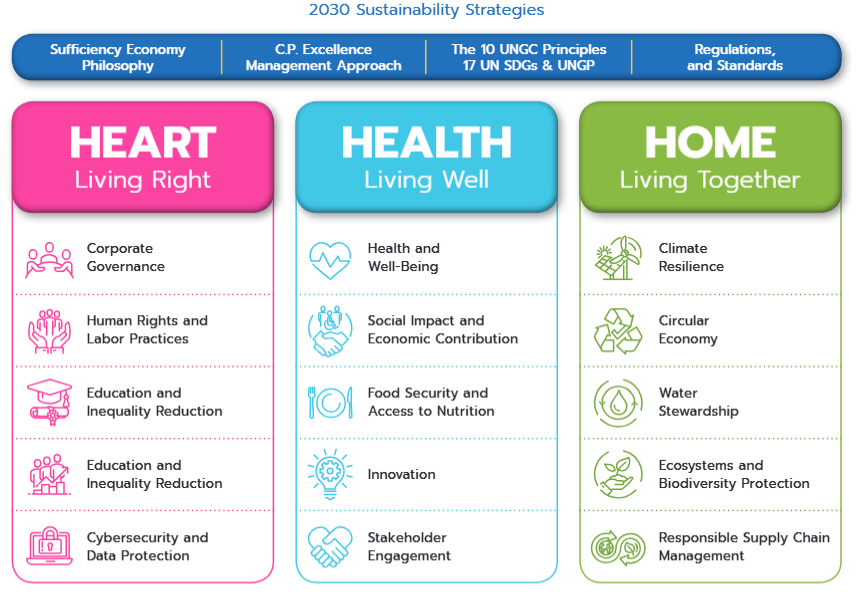
Heart: Living Right or Governance Strategy, this strategy consists of five goals, long-term targets, and outcomes as follows:
• Corporate Governance
Target: Pass the annually corporate governance assessments, by the external verification or institution.
Result: Achieved the target, the Company has achieved the Thai Listed Companies Corporate Governance Assessment from Thai Institute of Directors (IOD) by receiving an "Excellent" (5-stars) rating for the 8 consecutive years.
• Human Rights and Labor Practices
Target: Conduct annual human rights impact assessments for high-risk organizational activities and direct suppliers.
Result: Achieved the target, Completing the annual human rights impact assessment for the organization and its suppliers.
• Education and Reducing Inequality
Target: 150,000 people gain access to quality education, lifelong learning opportunities, and essential skill development.
Result: Achieved the target, with 191,901 people participating the SME's upskilling programs i.e "Makro Retailer Alliance" and "Chef's Club by makro".
• Leadership and Human Resource Development
Target: All employees receive training and development for essential job skills.
Result: Achieved the target, 100% of employees receiving necessary training and skill development.
• Cybersecurity and Data Protection
Target: The company achieves international standards for cybersecurity and data privacy certifications.
Result: Achieved target, with the company receiving NIST assessment scores for the 3rd consecutive year. The Company's average score is 4.22 (while National average score is 1.91)
Health: Living Well or Social Strategy, target and result as following:
• Health and Well-being
Long term target: 70% of sales come from products and services that promote health and well-being by 2030.
Annual Target: At least 50%
Result: Achieved the annual target, with 52.34% of sales products and services that promote health and well-being. and also increased from previous year which was 50.13%.
• Social Impact and Economic Contribution
Long term target: Creates jobs or income for 400,000 people in communities by 2030.
Annual Target: At least 219,000 people.
Result: Achieved annual target, generated income for 252,274 people, increase 6,667 people as compare last year.
• Food Security and Access to Nutrition
Long term target: 150,000 youth and individuals gain access to safe and nutritious food by 2030
Annual Target: At least 100,000 people.
Result: Achieved the annual target with 309,260 people gaining access to safe food, which significantly increased of 201,254 people from the previous year, driven by the donation of surplus food to those who needs.
• Innovation
Target: Register 6 patents by 2030
Result: Achieve target, with 10 patents have been registered.
• Stakeholder Engagement
Target: Stakeholder engagement score at least 80%.
Result: Achieved the target, with an engagement score is 93%.
Home: Living Together or Environmental strategy, which result of business units in Thailand, Myanmar, Cambodia and Malaysia as following:
• Climate Resilience
Long term target by 2030: Reducing scope 1&2 emissions by 42% and Scope 3 emissions by 25%, and aim to Net-zero carbon emissions by 2050.
Annual target: Reduce scope 1&2 emissions at least 8% and increase renewable energy utilization 2%.
Result: Partial achieved the annual target, the renewable energy utilization ratio's increased from 13.96 last year to be 16.23% which is above the target. But Scope 1 & 2 emissions increased by 45,013 tons CO2eq. or 5.21% year-on-year. This was driven by the 3-year maintenance cycle of refrigeration systems across branches in Thailand, and higher fuel consumption from own delivery vehicles in Malaysia due to the growth of online sales orders.
• Circular Economy
Long term target: Zero waste and food waste sent to landfills by 2030
Annual Target: Reduce volume of food waste to landfills at least 50% of total generated food waste.
Result: Achieved the annual target, reduce 42.18% food waste to landfills of total generated food waste. This is significantly improvement performance compared to previous year which was 14.21%.
• Water Stewardship
Long term target: Reduce 20% of water intensity per revenue by year 2030
Annual Target: Reduce water intensity per revenue at least 5%
Result: Not achieved annual target, but the water intensity per revenue 11.01 cubic meters per million Baht in 2025 that slightly improved 0.05 cubic meters per million Baht compared to last year.
• Ecosystem and Biodiversity Protection
Target: 100% of business units and tier 1 suppliers do not encroach on declared conservation areas, and 100% of high-risk raw materials are traceable.
Result: Achieved the target, the 100% of store and distribution center also tier 1 supplier are not in the natural heritage reservation area and 100% traceability of high-risk raw materials.
• Responsible Supply Chain Management
Target: 100% of suppliers assessed ESG assessment criteria by 2025
Result: Achieved the target, as the significant suppliers assessed 100% compared to 95.67% from last year.
Remark: Environmental target and performance coverage all operation units in Thailand and international and recalculated back to based line year. The data and the assurance letter shown in the attachment#9 of this report
Recognition award and global rating
S&P Global Corporate Sustainability Assessment with score 88/100 (on 11 December 2025) which improve from score 84/100 from the previous year. Furthermore, the company has been announced as member The Sustainability Yearbook 2025, with ranked as "Top 5%" of Food & Staples Retailing which improved from Top 10% from previous year.
Achieved of 2025 SET ESG Ratings from the Stock Exchange of Thailand with “AAA” rating (score 93/100)
FTSE Russel ESG Rating as 4.6/5.0 and maintained membership in "FTSE4Good index series" for 6 consecutive years (2020-2025)
MSCI ESG Rating as “A” level which improve from BBB in last year.
Achieved "B" level from CDP in 3 categories which are Climate, Forests and Water security and "A" level of supplier Engagement Assessment (SEA category).
Certified as the member of Thai Private Sector Collection Action Against Corruption (CAC) which valid year as 2025-2028.
UN Sustainable Development Goals
| SDG Goal |
|---|
| Goal 1 No Poverty |
| Goal 2 Zero Hunger |
| Goal 3 Good Health and Well-being |
| Goal 4 Quality Education |
| Goal 5 Gender Equality |
| Goal 6 Clean Water and Sanitation |
| Goal 7 Affordable and Clean Energy |
| Goal 8 Decent Work and Economic Growth |
| Goal 9 Industry, Innovation and Infrastructure |
| Goal 10 Reduce Inequalities |
| Goal 11 Sustainable Cities and Communities |
| Goal 12 Responsible Consumption and Production |
| Goal 13 Climate Action |
| Goal 14 Life below Water |
| Goal 15 Life on Land |
| Goal 16 Peace, Justice and Strong Institutions |
| Goal 17 Partnerships for the Goals |
Policy Review
Policy Reviewed This Year
Yes
Policy Changed This Year
Yes
Review Details
In 2025 report, the Company has improved the publicly discloses the ESG performance cover global wide business units in Thailand, Malaysia and expand coverage to Myanmar and Cambodia. The coverage as 97% of total revenue or 99.46% of total operation sites. The data has been consolidated and verified by external third party (LRQA) as the assurance letter on last page of attachment#9 of this report
Business Value Chain
Value Chain Description
The Company emphasizes the engagement both direct and indirect stakeholders. Their feedback and expectation are considered and managed throughout the analyzing, categorizing and periodically reviewing the engagement channels. The groups of stakeholders are identified as follow.
• Direct groups: Employees, Shareholders and Investors, Customers and Entrepreneurs, Supplier (including local SME and farmer), Contractors, and Community and Society.
• Indirect groups: Financial Institutions, Government, Mass Media, NGO and ESG Rating Agency.
Stakeholder Analysis
Stakeholder Analysis
| Stakeholder Type | Stakeholders | Stakeholder Expectations | Response to Expectations | Communication Activities |
|---|---|---|---|---|
| External stakeholders | 2904 · Description: Investors or investment institutions · 2913 · Description: Shareholders | • Accurate, complete, and timely information disclosure
• Transparency management
• Protect shareholder's rights
• Business growth & competitiveness
• Comply with stock market’s new CG and transparency disclosure | • Corporate governance
• Stakeholder engagement
• Innovation product & service
• Cybersecurity & data privacy | 2944 · Description: Annual General Meeting (AGM) · 2949 · Other name: Quarterly Analysts Meeting, and Investor meeting · Description: Others |
| Internal stakeholders | 2921 · Description: Employees | • Benefit, welfare, compensation, and career growth.
• Safe working condition and equipment.
• Work life balance
• Upskill and reskill for modern competency.
• Equality, non-discrimination diversity and inclusion for migrant worker at store. | • Human rights - Non-discrimination.
• Health & safety.
• Human capital development.
• Human rights - migrant workers | 2941 · Description: Online Communication · 2942 · Description: Internal Meeting · 2945 · Description: Complaint Reception · 2946 · Description: Employee Engagement Survey · 2947 · Description: Satisfaction Survey |
| External stakeholders | 2923 · Description: Customers | • Ontime delivery with safe, quality and promote health.
• Affordable food prices.
• Stock availability.
• Reliable & traceable product label & information.
• Personal data protection.
• Product and service that support the competitiveness for entrepreneur customers. | • Supply chain management.
• Health & well Being product.
• Innovative product & service.
• Cyber security and data privacy.
• Education & inequality reduction for customer who's small entrepreneur. | 2941 · Description: Online Communication · 2945 · Description: Complaint Reception · 2947 · Description: Satisfaction Survey |
| External stakeholders | 2899 · Description: Suppliers | • Support agricultural products local SME and farmer.
• Fairness and transparency supplier selection process.
• Better understand the certified sustainable agriculture product requirement. | • Job creation and local SME and farmer.
• Supply chain management
• Stakeholder engagement
• Supplier's capacity building | 2938 · Description: Visit · 2941 · Description: Online Communication · 2945 · Description: Complaint Reception · 2947 · Description: Satisfaction Survey · 2948 · Description: Training / Seminar · 2949 · Other name: Supplier audit and capacity-building program. · Description: Others |
| External stakeholders | 2918 · Description: Contractors | • Selection and encourage business partners with transparency.
• Better understand the human rights and labor practice in Supplier’s Code of Conduct manual.
• Knowledge sharing for road accident prevention. | • Job creation for small local service company and worker
• Supply chain management
• Human rights & labor practice
• Health & safety - road safety | 2938 · Description: Visit · 2941 · Description: Online Communication · 2945 · Description: Complaint Reception · 2947 · Description: Satisfaction Survey · 2948 · Description: Training / Seminar · 2949 · Other name: Monthly meeting · Description: Others |
| External stakeholders | 2902 · Description: Community | • Collaborative with local firms to develop and support communities.
• Job and carrier opportunities for local community members.
• Protection of accident and environmental impact on the community.
• CSR activities / donations / continuous support during the crisis or natural disaster
• Support for student’s education in community. | • Social impact job creation and economy contribution.
• Wastewater & waste management.
• Health & safety.
• Food security and access to nutrition.
• Education & inequality reduction | 2938 · Description: Visit · 2941 · Description: Online Communication · 2945 · Description: Complaint Reception · 2947 · Description: Satisfaction Survey |
| External stakeholders | 2925 · Description: Financial institution | • Strict compliance with accuracy, transparency, and punctuality principles.
• Compliance with contractual terms and conditions.
• Climate change target and action.
• Encourage climate change and social support to local farmer. | • Corporate governance.
• Job creation and economy impact to local.
• Climate resilience target and action plan | 2938 · Description: Visit · 2939 · Description: Press Release · 2941 · Description: Online Communication · 2943 · Description: External Meeting · 2944 · Description: Annual General Meeting (AGM) |
| External stakeholders | 2931 · Description: Government agencies and Regulators | • Compliance with legal and regulation.
• Support activities beneficial to the community, society, and the environment.
• Encourage BCG Model and protect natural resource.
• Encourage and protection of human right in among value chain.
• Collaboration to prevent food shortage from demand and supply including control or reduce price for end user during economic concern. | • Corporate governance.
• Supply chain management.
• Human rights & labor practice.
• Circular economy.
• Climate resilience.
• Water stewardship.
• Food security & access to nutrition
• Product quality control
| 2938 · Description: Visit · 2939 · Description: Press Release · 2940 · Description: Social Event · 2943 · Description: External Meeting · 2949 · Other name: Collaborative agreements with government agencies. · Description: Others |
| External stakeholders | 2929 · Description: Media | • Communicate relevant, factual, and timely performance.
• Strategy for business impact on the economy and society | • Corporate governance - transparent.
• Social impact, economic contribution and environment | 2939 · Description: Press Release · 2941 · Description: Online Communication · 2947 · Description: Satisfaction Survey |
| External stakeholders | 2936 · Other name: ESG Rating Agency & NGO · Description: Others | • Human rights along supply chain.
• Supplier screening with ESG criteria.
• Carbon reduction strategy in own operation and supply chain
• disclosure as TNFD guideline
• Prevent ocean plastic waste.
• Promote the gender equity in supply chain
• Animal welfare
• Responsible marketing of alcohol beverage (new topic) | • Supply chain management.
• Climate resilience.
• Sustainable packaging.
• Biodiversity & ecosystem protection.
• Human rights - indigenous
• Human rights - non-discrimination within the supply chain
• Enhance animal welfare; 5 freedoms principles in supply chain and purchase egg free cage from farmers.
• Strict the alcohol sales hours and condition also adheres to bans on influencer marketing and sponsorships for alcohol beverage products including public disclosed policy and performance on website | 2941 · Description: Online Communication · 2942 · Description: Internal Meeting · 2943 · Description: External Meeting · 2945 · Description: Complaint Reception · 2947 · Description: Satisfaction Survey · 2948 · Description: Training / Seminar · 2949 · Other name: Research and discussion, and Participate disclosure and rating program. · Description: Others |
Environmental Policy & Guidelines
Has an Environmental Policy
Yes
Policy Description
Environmental Management
To preventing the pollution and minimizing the environmental impact of our operation and being the organizational practice also advocates employees and all related business partners through the value chain to acknowledge and perform this policy as duties and responsibilities. 1) Compliance with all relevant environmental laws and regulations in every country that has operated. 2) Operation of our business, facility, distribution, and logistics include the activity of suppliers, contractors including service providers in a manner that prevents and minimizes the environmental impact with proper management of waste. 3) Develop products and services that can be operated, produced, distributed, used, disposed or recycled in a safe and sustainable manner 4) Review existing and potential environmental risks and manage through the Company’s risk management processes and this information shall be considered during the merger and acquisition process. 5) Set targets and objectives to reduce environmental impacts and public disclosure of the annual environmental practices, performances, and targets as annual basis. 6) Continuous improvement of environmental performance and collaboration with suppliers, contractors, and service providers for the reduction of the environmental impact from the Company’s operations. 7) Train employees and workers to understand the impact of their work activities on the environment. Altogether, raise internal and external stakeholders’ awareness.
Energy Management
The Company places high importance on energy conservation and improve utilization efficiency. All executives and employees are required to actively support and take responsibility for efficient energy use to ensure continuous sustainability and collaboration across all stakeholders with the practices as follows: 1) Establish targets, and action plans for energy conservation, with regular reviews of their effectiveness every year. 2) Promote energy conservation activities, ensuring a balanced and appropriate use of natural resources and the environment, in alignment with the growth of the business and the organization. 3) Comply with all laws and regulations related to energy use, energy consumption, and energy efficiency. 4) Emphasizing the importance of involving relevant personnel and fostering awareness to all stakeholder 5) Design, procurement, and acquisition of machinery, tools, equipment, and other necessary to enhance energy performance. 6) Continuously improve energy performance with increasing energy efficiency and appropriately applying it to various activities. 7) Provide adequate resources and information for implementation.
Renewable and Clean Energy
The company aims to continuously increase the proportion of clean energy usage every year, striving towards RE100. This will be achieved through initiatives such as installing solar rooftops, solar thermal systems, transitioning fuel vehicles, forklifts, and transport trucks to electric and hydrogen energy. These efforts aim to drive a significant transformation in the logistics systems of wholesale-retail business towards clean energy throughout the supply chain. In 2024, the Company's % of clean energy per total energy utilization reached 16%, up from 13% in 2023.
Water Management
The Company commits to reduce 20% of water consumption per revenue compared with baseline year within 2030 which framework as 1) Assess water risk facility of own operation and critical tier 1 that is located within or nearby water stress areas which are quantity, quality or water pricing structure, flooding, water conflict, regulation, water pricing structure or other significant water risks. Including water use assessment to identify opportunities for water efficiency improvement. 2) Set up a long-term plan with the target to reduce water consumption and intensity such as rainwater reservoir, maintenance program to prevent water leakage, utilize water-saving equipment, and application of water recycling including action to improve wastewater quality monitoring to ensure its complied with the legal requirement. 3) Train and communicate to raise awareness related to the water efficiency management program to the employees, temporary workers, contractors, and critical tier-1 suppliers who have high risk in the water stress area. 4) Encourage key business partners, service providers and contractors from the production, transportation, storage, distribution and trading to implement the water-saving program and increase water recycling. 5) Encourage key business partners, service providers and contractors from the production, transportation, storage, distribution and trading to implement the water-saving program and increase water recycling. 6) Collaborate with other organizations such as government, education institutes, community, etc. to find the opportunities for corporative solving the water risks
Waste Management
The majority waste of business operations is food waste while other waste materials such as paper and plastic are reused and sent to recycle process. To mitigate risk of negative impact to the environment, the Company commits to achieving zero waste and food waste to landfills within 2030 and has a framework as 1) Measuring food loss & food waste with the acceptable method and breaking down volumes by category and/or lifecycle stage or processing flow to identify the critical area for improvement. 2) Define an appropriate action plan and target that may have economic, environmental, or social benefits instead of being discarded without any value creation such as design the packaging to extend the product's shelf life, the appropriate inventory planning, destinations, and repurposing actions may include any utilized for other processes including the alternative uses of waste and food waste which based on food safety practice. 3) Train and communicate to raise awareness related to food loss & waste reduction actions and targets to the employees, temporary workers, contractors, and suppliers in the supply chain. 4) Collaborate and encourage the up/downstream partners, service providers, and contractors among production, transportation, storage, distribution, and trading to reduce the amount of food loss & waste in the value chain. 5) Publicly disclose the status of the food waste & food loss reduction program and performance compare targets as annual basis 6) Collaborate with other organizations for corporative solutions the food loss & waste.
Biodiversity Management
The company is committed to aims to create a "positive impact" to halt and restore the natural losses caused by its activities, its partners, or business alliances along the supply chain by the year 2030. To protecting, conserving, and sustainably managing forests "No Gross Deforestation" by the year 2030 altogether announcing the policy of "Do not catch, do not buy, and do not sell juvenile marine animals" at every store. The objective is to promote not selling and buying juvenile marine animals starting from the proper sourcing, defining & inspect the size and species, equipment, and fishing methods, ensuring no adverse impact on the environment. Additionally, the company is providing training and raising awareness among supplier, producers, traders, and fishing groups throughout its supply chain. Altogether, actively collaborating with government. This initiative aims to drive behavioral changes to the sustainable fishery.
Greenhouse Gas and Climate Change Management
The Company commits to achieving Carbon neutrality from our operation with 42% reduction of Scope 1&2 and 25% of Scope 3 by 2030 and “Net Zero Emission within 2050” which has the framework as 1) Evaluate risk, opportunity, and impact from climate change through the supply chain both upstream and downstream with trustable methodology as TCFD framework and integrated to the Company’s risk assessment process 2) Set up the long-term plan, appropriate scope and target to improve energy efficiency, energy-saving, increasing renewable energy or clean energy proportion include applying technology or innovation to reduce overall energy consumption. 3) Train and communicate to raise awareness that related to climate change to the employees, temporary workers, contractors and other workers in the supply chain. 4) Encourage key business partners, service providers and contractors from the production, transportation, storage, distribution and trading to reduce carbon emission through the supply chain. 5) Publicly disclose the status of climate change project’s performance compares targets as annually basis. 6) Collaborate with other organizations such as government, education institutes, community, etc. to find the opportunity for corporative solving the climate change issue. For more detail about the executive and working team for climate-related governance and management, Risk-opportunity and business's financial strategies, and impact can be found at the special report (TCFD report) at company's website
Policy Document Link
https://www.cpaxtra.com/storage/document/sustainability/environmental-policy-en.pdf
Page Number in Report
3-5
Environmental Guidelines
| Guideline |
|---|
| Electricity Management |
| Fuel Management |
| Renewable/Clean Energy Management |
| Water Management |
| Waste Management |
| Biodiversity Management |
| Greenhouse Gas and Climate Change Management |
Environmental Policy Review
Policy Reviewed This Year
Yes
Review Details
To align with Charoen Pokphand Group's climate resilience target and result of ESG materiality analysis. Hence The Company expand ESG including GHG emission which cover to international business units in Malaysia, Myanmar (new) and Cambia (new). Presently, the company's coverage 97% of revenue see more detail within the external assurance statement in attachment#9 of this report
Policies & Guidelines Changed
| Change |
|---|
| Electricity Management |
| Fuel Management |
| Renewable/Clean Energy Management |
Energy — Plan & Guidelines
Has an Energy Management Plan
Yes
Plan Description
To achieve the commitment to increase renewable energy utilization ratio to 25% and reduce energy Intensity per revenue by 25% by 2050. The action for energy management as follow.
Projects for reducing the energy consumption
High-efficiency chillers project
LED Replacement and installation project
Change the Fixed-speed air conditioners to VRF (Variable Refrigerant Flow)
Projects for Increase utilization of Clean or Renewable Energy
Rooftop solar at stores and distribution centers
Solar Thermal for Water Heater
Solar tube for lighting at head office
Converted to an electric forklift in own operation
BEV and HEV for online delivery service (by vendor)
Innovations for energy saving
Innovation projects for energy saving that initiated by employee
Install tube and screen to reuse cooled water
Shorten water looping piping system to reduce pump’s power consumption.
Training and motivation
Energy and GHG policy
Energy conservation training program for mechanic
Energy-saving awareness
Annual energy-saving event every year
Energy — Electricity Consumption
Electricity Consumption
| Metric | Current Year | Previous Year | Two Years Ago |
|---|---|---|---|
| Total electricity consumption within the organization (Kilowatt-Hours) | 1,791,569,606.83 | 1,690,547,594.31 | 1,585,299,169.8 |
| Electricity purchased for consumption from non-renewable energy sources (Kilowatt-Hours) | 1,494,631,180 | 1,447,890,449 | 1,377,873,446 |
| Electricity purchased or generated for consumption from renewable energy sources (Kilowatt-Hours) | 296,938,426.83 | 242,657,145.31 | 207,425,723.8 |
Energy — Fuel Consumption
Fuel Consumption
| Metric | Current Year | Previous Year | Two Years Ago |
|---|---|---|---|
| Crude oil (Barrels) | 0 | 0 | 0 |
| Coal (Metric tonnes) | 0 | 0 | 0 |
| Jet fuel (Litres) | 0 | 0 | 0 |
| Diesel (Litres) | 6,279,242.3 | 6,459,647.84 | 6,715,989.37 |
| Gasoline (Litres) | 1,991,274.9 | 1,910,564.45 | 1,860,281.56 |
| Fuel oil (Litres) | 0 | 0 | 0 |
| Natural gas (Standard cubic feet) | 0 | 0 | 0 |
| LPG (Kilograms) | 1,255,970.92 | 1,056,321.55 | 1,032,680.1 |
| Steam (Metric tonnes) | 0 | 0 | 0 |
Other Fuels
| Fuel | Unit | Current Year | Previous Year | Two Years Ago |
|---|---|---|---|---|
| Ethanol | 1673 · Description: Litres | 1,182,416.47 | 763,000.94 | 796,051.48 |
Energy — Targets
Has Set Targets
Yes
Targets
| Target | Base Year | Base Year Value | Target Year | Target Change (%) | Unit |
|---|---|---|---|---|---|
| Increase of electricity and fuel consumption from renewable energy sources | 2,020 | 44,063.02 | 2,030 | 25 | Megawatt-Hours |
Energy — Performance & Outcomes
Has Performance Results
Yes
Performance Description
2025 Result of total Energy saving from projects
Total Energy efficiency increased by 6.34 %
Total Cost saving for energy 225,693,676.23 Baht
Result of projects for reduce the amount of energy consumption
Energy Saving 79,777,551 kilowatt-hours per year
Result of projects for Increase the clean or renewable energy utilization
Total renewable Energy 307,046,970 kilowatt-hours per year from below projects;
Rooftop solar at stores and distribution centers total of 1,239 stores which increased 265 sites from previous year.
Solar Thermal Water Heater
Solar tube for lighting at head office
Converted to an electric forklift in own operation total of 867 units, increased 20 units from previous year and
BEV and HEV for online delivery service (by vendor) total of 201 units which increased 154 units
Result of innovations for energy saving
Invest 310,200,000 Baht
Energy Saving = 321,796,296 increased 45,638,505.18 kilowatt-hours per year
Saving energy cost 213,763,016 increased 118,992,804.6 Baht
Result of training and motivation
100% responsible employees are trained and communicated
100% of employee participate energy saving program
Projects and/or Awards
"Solar Rooftop" Project
The results of our commitment to conducting business in an environmentally friendly. Generate electricity from solar energy through rooftop installations at distribution centers and both wholesale and retail business, totaling 1,239 stores increased 265 stores. Additionally, our retail business has been recognized with an energy-efficient building award from the Metropolitan Electricity Authority (MEA) for promoting energy efficiency improvements and enhancing indoor air quality.
2025 results:
Reduce energy consumption 296,938,430 which improved from last year as 21,152,389.18 kilowatt-hours.
Cost saving 112,950,798, improved 19,667,586 Baht from last year.
Avoid greenhouse gases emission 142,624.89 tons of CO2 equivalent which improved 48,268.13 tons of CO2 eq. compared last year.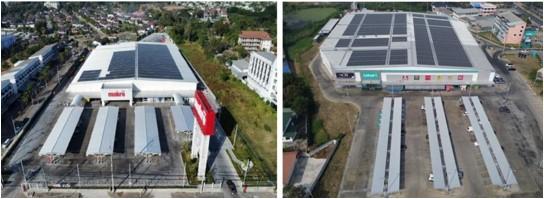
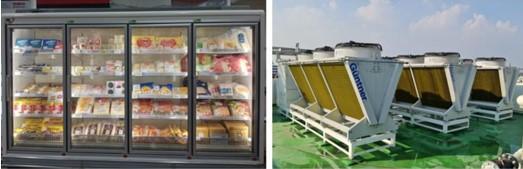
"Replace Refrigerant with "Water-Loop Cooling System and Green Refrigerant" Project
The refrigerant is significant energy consumption and carbon emission at stores. Replacing the refrigerant with a water looping system can improve energy efficiency by the smaller size of the compressor and reduce GHG emissions from refrigerant filling during maintenance. Currently, 170 stores (increased 159 stores) have transitioned to using natural refrigerants, covering a total of 12,355 refrigeration units, increased 11,980 units from last year. There are also plans to expand this initiative to all branches in the future.
2025 results:
Reduce energy consumption 9,250,764 kilowatt-hours, improved 8,879,014 kilowatt-hours from last year.
Cost saving 37,011,550 Baht per year. increased 35,524,550 Baht from last year.
Avoid greenhouse gases emission 4,623.70 tons of CO2 equivalent improved 4,438.70 tons of CO2 eq. from last year
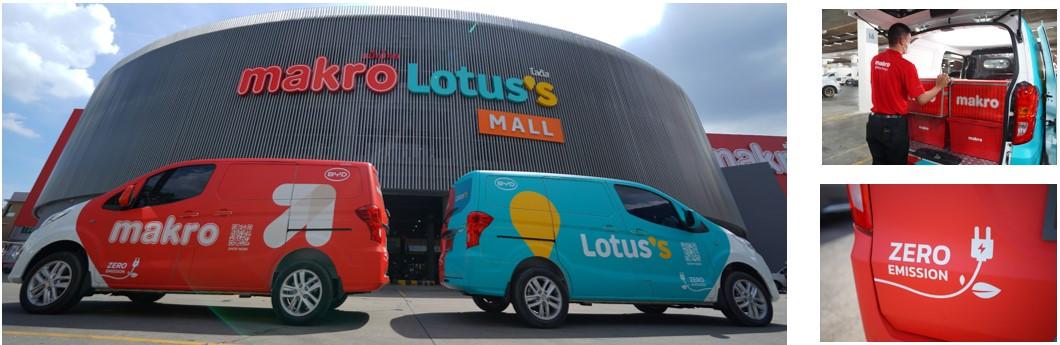
"Utilize EV Truck and Bike for Transportation and Delivery service" Project
EV tractor and EV pickup trucks are operated between distribution center and stores. Furthermore, all of store utilizes EV forklift and delivery fleet are EV truck and bike which decrease greenhouse gases emission, energy consumption and costs.
2025 results:
201 EV pickup trucks for delivery increased 154 units from last year.
867 EV forklifts which increased 20 units from last year.
Reduce energy consumption 119,306,606.23 Baht, which improved 17,391,210.69 Baht from last year.
Avoid greenhouse gases emission 10,001.57 tons of CO2 equivalent, improved performance as 1,078.04 tons of CO2 eq. compared to previous year.
"Smart AI Building Automation (SBEMS)" Project
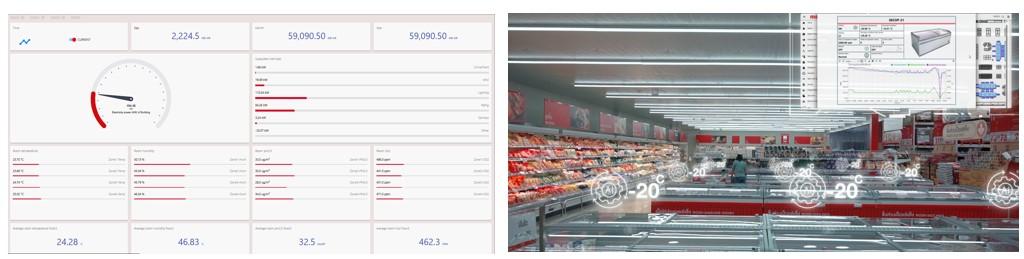
Energy Management through the SBEMS platform integrates building engineering systems into a single centralized platform, utilizing AI and IoT sensors for real-time and precision control. The system automates electrical loads, including refrigeration optimization, automated indoor lighting synchronized with natural light. Altogether stabilized air conditioning temperatures by calculating the internal heat load. Furthermore, SBEMS covers utility systems and emergency response systems via a 24/7 cloud network, with all data visualized on a Digital Monitoring Dashboard. This allows the company to track energy instantly, save energy, reduce environmental impact, and prevent losses. It also minimizes maintenance, maintains product quality, and extends equipment lifespan, while enhancing customers’ comfort. The system is currently operational across 127 stores.
2025 results:
Reduce electricity consumption by 9,889,363 kilowatt-hours per year.
Reduce energy costs by 39,557,452 Baht per year.
Avoid greenhouse gases emission to 4,943.69 tons of CO2 eq.
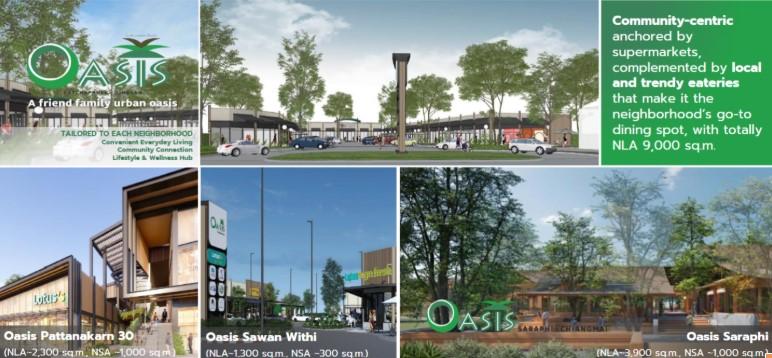
"lotus's oasis" Project
Developed under the concept of “The Community’s Oasis of Happiness,” this project creates a green space that seamlessly connects nature with local culture. The design integrates authentic elements such as Luntaya patterned fabrics, bamboo, and traditional wickerwork. Furthermore, the facility is designed as an energy-efficient building, featuring solar panel installations and high-efficiency lighting and cooling systems to significantly reduce energy consumption.
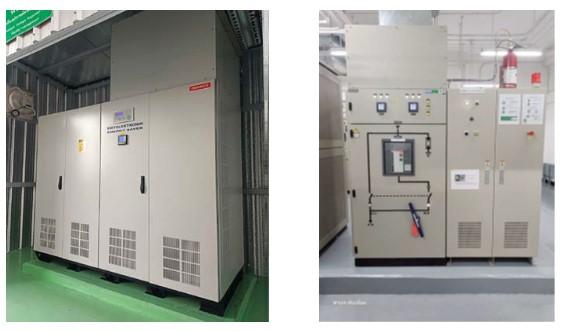
"Automatic Voltage Regulator (AVR)" Project
The company has implemented Automatic Voltage Regulators (AVR) across 23 stores to optimize and stabilize incoming voltage. By reducing electrical waste caused by overvoltage, we effectively minimize unnecessary energy consumption.
2025 results:
Reduced electricity consumption by 5,717,739 kilowatt-hours per year.
Reduce energy costs by 24,243,216 Baht per year.
Avoid greenhouse gases emission to 11,435 tons of CO2 eq.
Water — Plan & Guidelines
Has a Water Management Plan
Yes
Plan Description
As climate change is seeing intensified flooding and drought year on year, the Company recognizes the water stewardship and resource management efficiency throughout the water life cycle to sustain an economic-ecological co-development that adds economic value to communities without encroaching on natural resources.
The Company announces the long-term target to reducing water consumption per revenue unit 20% compared with baseline year or 2% per year. In areas prone to water scarcity and optimizing wastewater for maximum economic-social value while raising water stewardship awareness in the process.
Water Risk Assessment
Annually monitoring by applying the aqueduct water risk mapping tool. The Company has thus planned effective water management to increase water usage efficiency and risk management along the supply chain.
Water Saving and Conservation programs
The water saving and conservation programs to increase efficiency of the water utilization and reduce the water withdrawal from water stress area. The significant programs are implemented as the recycling effluent from wastewater treatment plant, the installation of water saving equipment, the rainwater collecting tank and the ground water bank project etc.
Creating Awareness
Communicate through the company’s media, including pictures and stickers, to raise water stewardship awareness to employees, customer, and public
Communicate and conduct training to Suppliers in the water stress area and enhancing them to implement the water conservation program.
Wastewater Management
Install wastewater treatment systems at all stores.
Monitor wastewater effluent and set the target as zero wastewater complain or breach case from the stakeholders.
Water — Withdrawal, Discharge & Consumption
Water Withdrawal, Discharge & Consumption
| Metric | Current Year | Previous Year | Two Years Ago | Remark |
|---|---|---|---|---|
| Total water withdrawal (Cubic meters) | 16,485,945.63 | 15,505,427.77 | 15,164,231.33 | |
| Total water withdrawal by third-party water (Cubic meters) | 16,400,462.32 | 15,327,603.87 | 15,017,108.6 | |
| Total water withdrawal by surface water (Cubic meters) | 8,640 | 8,640 | 0 | Volume of surface water = 0 + rainwater 8,640 m3 |
| Total water withdrawal by groundwater (Cubic meters) | 76,843.31 | 169,183.9 | 147,122.73 | |
| Total water withdrawal by seawater (Cubic meters) | 0 | 0 | 0 | |
| Total water withdrawal by produced water (Cubic meters) | 0 | 0 | 0 | |
| Percentage of wastewater treated before discharge (%) | 100 | 100 | 100 | |
| Total water discharge (Cubic meters) | 10,753,645.27 | 9,840,085.1 | 10,001,643.87 | |
| Total water discharge to third-party water (Cubic meters) | 2,557,133.64 | 2,333,955 | 1,893,940.45 | |
| Total water discharge to surface water (Cubic meters) | 8,196,511.63 | 7,506,130.1 | 8,107,703.42 | |
| Total water discharge to groundwater (Cubic meters) | 0 | 0 | 0 | |
| Total water discharge to seawater (Cubic meters) | 0 | 0 | 0 | |
| Total water consumption (Cubic meters) | 5,732,300.36 | 5,665,342.67 | 5,162,587.46 | |
| Recycled water (Cubic meters) | 78,495 | 45,804 | 34,124 |
Water — Targets
Has Set Targets
Yes
Targets
| Target | Base Year | Base Year Value | Target Year | Target Change (%) | Unit | Per Unit (Intensity) | Per Unit — Please Specify |
|---|---|---|---|---|---|---|---|
| Reduction of water consumption | 2,020 | 9.86 | 2,030 | 20 | Cubic meters | Other | per revenue million Baht |
Water — Performance & Outcomes
Has Performance Results
Yes
Performance Description
Results of Water Risk Assessment
The company set an annual target to comprehensively assess the operational areas of the company and its Tier 1 partners. The results achieved the set targets as follows:
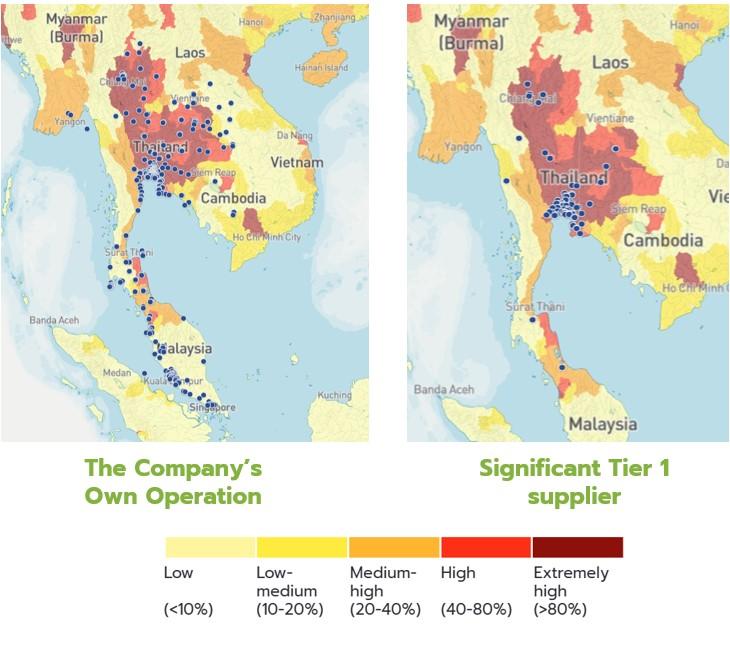
• 100% of the company's operational areas and all Tier 1 partners have been assessed for water scarcity risks annually. The assessment utilized the Aqueduct Water Risk Atlas tool, and 100% of all stores and distribution centers, as well as critical tier 1 suppliers, have completed the assessment which achieved the target of the action plans.
• The annual result of facilities located on water stress area is similar to previous year's. The company's own facilities is 73% same as last year while the critical tier 1 supplier's 90% which is 3% lower than last year. See the water stress map as below pictures.
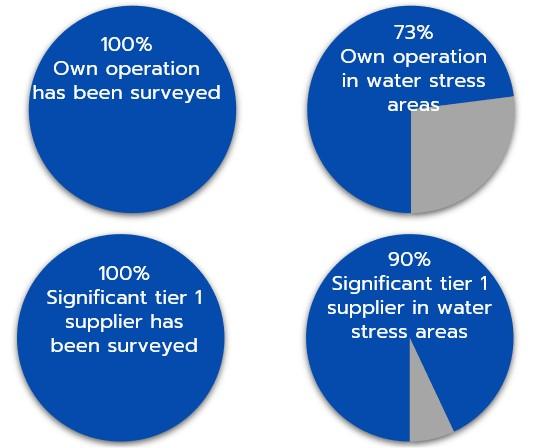
Results of Water Risk Assessment
Measures to Mitigate Water Risks
Since 2018, The Company has continuously implemented the "Save Water, Saving the Future" project. In 2025, the result as:
72 stores and 1 distribution center have implemented systems to reuse treated wastewater.
2 stores installed rainwater storage tanks for watering plants and cleaning parking lot.
3 stores implemented underground water bank projects to return treated water to the environment, enhancing soil moisture around the stores.
% of sourced agricultural commodities from water-stressed areas
In 2025, The Company also conduct survey water stress by 100% of sourced agricultural commodities originating from water-stressed areas. The result found that 53-98% of agricultural commodities from the water stress area are higher than last year according to country's circumstance. The survey of each category as;
Agricultural product | % based in water-stressed areas | Agricultural product | % based in water-stressed areas |
Cattle products | 94% | Sugar | 53% |
Maize | 68% | Tobacco | 98% |
Palm Oil | 49% | Cotton | 59% |
Rice | 76% | Cassava | 68% |
Soy | 94% |
Survey Results and Risk Mitigation Measures for Supply Chain
• 81% face risks related to water quantity and quality. To address this, the company implemented risk mitigation measures, including the "Better Life for Highland Farmers" project. This project focuses on providing knowledge and promoting organic farming practices among farmers in the northern and northeastern regions, which face chronic drought issues. The project aims to improve agricultural production efficiency and reduce food loss. The company collaborates with the Department of Agricultural Extension and various universities to encourage farmers to adopt organic farming methods, such as drip irrigation, eliminating pesticide use, and transitioning to organic farming. Additionally, the company educates farmers on low-water-consumption crops that are in high demand, reducing food loss. The company also purchases produce from participating farmers for distribution nationwide.
• 18% face risks related to legal compliance and price structure changes. The main issue identified was partners' lack of understanding of water resource and environmental regulations. To address this, the company organized an annual partner meeting under the Responsible Supply Chain Development Project, which included discussions on partners' roles in preparing for water and environmental measures. The meeting aimed to inform partners about relevant water and environmental laws, changes in regulations, and the company's environmental requirements for partners. In 2025, 1,110 partners (100%) participated in this development program.
• 1% face risks related to water management violations and disputes. The survey found that rice-producing farmers were the significant risk group. As a result, the company selected rice-producing partners, such as Nakhon Luang Rice Mill in Kamphaeng Phet, as a case study for the Rice Production Model Project. This project focuses on efficient water and soil management practices, such as alternate wet and dry farming, organic fertilizer use, efficient water management, and proper rice straw management (avoiding straw burning) to reduce risks of violations and disputes related to water and environmental management with communities. Additionally, the company collaborated with the Professional Qualification Institute (Public Organization) to provide training on Level 4 Rice Quality Control and Inspection Standards for rice mill personnel to enhance their knowledge in sustainable rice production.

As a result of these initiatives, in 2025, there were zero cases of disputes or violations related to water and wastewater of both own operation and supply chain.
Waste — Plan & Guidelines
Has a Waste Management Plan
Yes
Plan Description
As a leading distributor of consumer products, applying the circular economy is paramount in attaining the Company's 2030 Sustainability Targets. Efficient resource utilization, including waste, is the essential strategy to manage resources for optimal utilization value and sustainable product and packaging to mitigate the business impact on society as much as possible. The opportunity of converting waste into products that add economic-social values.
The Company announce target zero waste and food waste to landfilled within 2030. which the waste management program is
Waste Management Program
As the setting target to be Zero waste and food waste to landfill by 2030 and minimum 50% reduction in 2025. The Company has approach and action for waste management and reduction as follow;
• Waste audits to identify opportunities for improving waste performance.
• 100% areas or function where waste is generated are identified, collect data, analysis, action plan and monitor the performance.
• Shrinkage minimization to prevention the waste generate, the cross function working team conduct monthly basis monitoring.
• 100% employee has trained the waste reduction policy and instruction.
• Food waste & waste utilization, for landfill diversion.
• Invest innovation and R&D to minimize waste such as near-expired food products are discounted or cooked and sold as ready-to-eat products. digital shrinkage management system, Black soldier fly feeding (Research with universities).
• Integration of recycling programs within every facility to reduce the waste sent to landfill.
• Waste diversion from landfill is certified by an independent accredited body.
• 5Rs to reduce the total waste to landfill.
5Rs Strategy for Waste Management
Reduce
• Not provide free plastic shopping bags to customers.
• Not selling deoxy plastic, products contain plastic microbeads and cap seals on beverage bottles.
2025 results:
• 100% implemented at every store
• 100% No product contains deoxy plastic, plastic microbead, and cap seal of beverage bottle.
Reuse
• Reuse material in operation i.e. plastic wrap, paper boxes, and palettes at stores and distribution centers.
2025 results:
• 72,915.62 tons general waste are reused which improved 6,179.08 tons compared to last year.
• 16,010.47 tons food waste are utilized improved 9,977.56 tons compared to last year.
Refuse
• Replace with recyclable PET plastic tray for sliced meat or fruit.
• Biodegradable material (Banana stem) as the packaging “Local Organic Vegetable”.
• Utilized plastic bags that a thickness not less than 40-micron (recyclable).
• 100% critical tier1 suppliers change the plastic external packaging to biodegradable material (Shelf ready display model).
2025 results:
• 1,796.45 tons. Replacement of recyclable PET which cause to reduce non-recyclable polystyrene packaging.
• 1,201 kg of banana stems are used to substitute the plastic packaging and sale amount is 3,431,430 Baht.
• 99.95% of own brand and operation are recyclable material.
Recycle
• Plastic and material from own operation are collected, segregated, and sent to recycling process (Wholesale 10,337.36 tons Retail 49,625.99 tons).
• Drop point at the store for collecting the plastic packaging from employees, customers, and communities total 44.52 tons
2025 results:
• 60,007.87 tons of plastic and 58,008.60 tons of paper waste from stores are sent to the recycling process.
Renewable
In 2025, the "Axtra Green Together" project deployed Drop Points and RVMs at 120 makro and Lotus’s stores to collect 42.20 tonnes of PET bottles for recycling into school uniforms. Additionally, the "Recycle Market" was held on weekends at 11 stores, allowing the public to sell recyclables to buyers.
For the 5 consecutive years, the company collected 1.99 tonnes of post-consumer PET plastic bottles from employees across 9 stores, delivered to Indorama Ventures to produce 200 jerseys for students in Samut Songkhram store. Meanwhile, the Phetchabun branch donated 1,976 Baht to Wat Chak Daeng temple which is the selling 328.66 kg of post-consumers PET bottles from store's staffs.
2025 results:
• 44.52 tons are upcycling to new materials or goods.
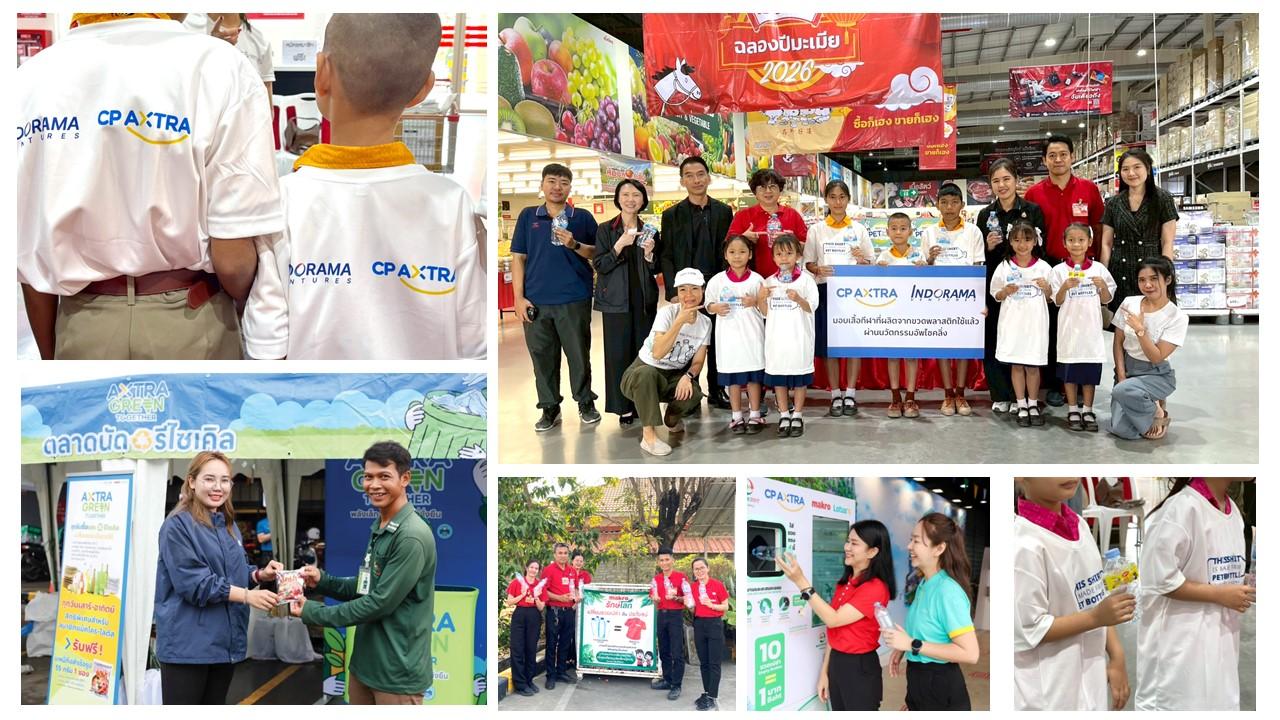
Food Waste Management
The Company's target to be Zero waste and food waste to landfill by 2030. The Company has an approach and action for food waste management and reduction as follow;1) Measuring food loss & waste with the acceptable method and breaking down volumes by category and/or lifecycle stage or processing flow to identify the critical area for improvement. 2) Define appropriate action plan and target that may have economic, environmental, or social benefits instead of being discarded without any value creation such as the appropriate inventory planning, destinations, and repurposing actions may include any utilized for other processes including the alternative uses of waste and food waste which based on food safety practice. 3) Train and communicate to raise awareness related to food loss & food waste reduction actions and targets to the employees, temporary workers, contractors, and suppliers in the supply chain. 4) Collaborate and encourage the up/downstream partners, service providers, and contractors among production, transportation, storage, distribution, and trading to reduce the amount of food loss & food waste in the value chain. 5) Publicly disclose the status of the food waste & food loss reduction program and performance compares targets as annual basis 6) Collaborate with other organizations such as government, education institutes, community, etc. to find opportunities for corporative solutions the food loss & waste such as The World Business Council for Sustainable Development.
The action to reduce food waste, which company are prioritized step through;
1) Shrinkage prevention: reducing food waste within the operational process. (Planning, Managing, Inventory, Discount).
2) Feed hungry people: Passing the food surplus to agencies, and people who need it.
3) Feed animals: Shifting to animal feed.
4) Composting: Convert to fertilizer or EM solution.
Waste — Generation, Disposal & Recycling
Waste Generation, Disposal & Recycling
| Metric | Current Year | Previous Year | Two Years Ago |
|---|---|---|---|
| Total waste generated (Kilograms) | 33,134,228.84 | 49,765,699.44 | 44,305,002.76 |
| Non-hazardous waste (Kilograms) | 32,994,062.14 | 49,138,067.84 | 44,096,561.77 |
| Non-hazardous waste - Landfilling (Kilograms) | 32,988,743.92 | 49,137,391.27 | 44,096,561.77 |
| Non-hazardous waste - Incineration (with energy recovery) (Kilograms) | 5,318.22 | 676.57 | 0 |
| Non-hazardous waste - Incineration (without energy recovery) (Kilograms) | 0 | 0 | 0 |
| Non-hazardous waste - Other disposal operations (Kilograms) | 0 | 0 | 0 |
| Hazardous waste (Kilograms) | 140,166.7 | 627,631.6 | 208,440.99 |
| Hazardous waste - Landfilling (Kilograms) | 134,770 | 626,332 | 207,358.99 |
| Hazardous waste - Incineration (with energy recovery) (Kilograms) | 0 | 278 | 0 |
| Hazardous waste - Incineration (without energy recovery) (Kilograms) | 5,396.7 | 1,021.6 | 1,082 |
| Hazardous waste - Other disposal operations (Kilograms) | 0 | 0 | 0 |
| Total reused/recycled waste (Kilograms) | 132,977,230.45 | 117,944,653.61 | 129,914,135.38 |
| Reused/Recycled non-hazardous waste (Kilograms) | 132,878,976.2 | 117,924,147.65 | 129,780,751.85 |
| Reused non-hazardous waste (Kilograms) | 72,915,619.77 | 66,736,537.65 | 116,816,681.78 |
| Recycled non-hazardous waste (Kilograms) | 59,963,356.43 | 51,187,610 | 12,964,070.07 |
| Reused/Recycled hazardous waste (Kilograms) | 98,254.25 | 20,505.96 | 133,383.53 |
| Reused hazardous waste (Kilograms) | 0 | 0 | 0 |
| Recycled hazardous waste (Kilograms) | 98,254.25 | 20,505.96 | 133,383.53 |
Waste — Targets
Has Set Targets
Yes
Targets
| Waste Type | Disposal Approach | Target | Target Year | Target Change (%) | Unit |
|---|---|---|---|---|---|
| Non-hazardous waste | 2758 · Description: Reuse · 2759 · Description: Recycle · 2760 · Description: Landfilling · 2762 · Description: Incineration without energy recovery · 2763 · Other name: Animal feed and composting · Description: Other | Increase waste utilization | 2,030 | 100 | Kilograms |
Waste — Performance & Outcomes
Has Performance Results
Yes
Performance Description
As the target to achieve "zero food waste to landfill and sustainable packaging within 2030". The actions have been implemented as the result of 2025, the general waste as paper, wood etc. has been reused and recycled 148,993.02 tons. While the food waste prevention by managed the order and stock can amount to 87,032.27 tons. The food waste is 37,488.93 tons; food loss is which total amounted 465.19 tons. Total generated food loss & waste volume is 37,954.12 tons. Anyway, this volume has been diverted from dumping to landfill 42.18% by donate as surplus food 236.08 tons, animal feed 13,091.26 tons, fertilizer 2,683.13 tons. Furthermore, the amount of food loss during distribution was found to be 465.19 tons. The company donated 1.96 tons to animal feed.
"Mai Tay Ruam - waste and food waste segregation” Project - 2 consecutive years
Since 2024-25, All wholesale and retail store signed the collaborate MOU with Bangkok Metropolitan Administration to join the “Mai Tay Ruam” project which the segregated food waste and general waste. The food waste will be composted and utilized in all public parks in Bangkok and the general waste is sent to recycling or energy converting process. Furthermore, the Company’s “Segregation is Reduction” project continue the campaign for color code garbage bags to promote the waste segregation behavior among customer and community.
2025 Result:
Reduce food waste to landfill 16,010.47 tons (wholesale 12,098.10 tons, retail 3,912.37 tons)
Food Waste Donation to the Wildlife Conservation Centers" and "Food Waste for Black Soldier Flies Feeding" Project "4 consecutive years
Wholesale and retail store continue the third year of food waste donation to feed the animal in zoo and national park. As the collaborative MOU with Ministry of Natural Resource and Environment, by Department of Environmental Quality Promotion, The Department of National Parks, Wildlife and Plant Conservation, the Zoological Park Organization of Thailand under the Royal Patronage, and Forestry Industry Organization. The Company’s supports the 18 Wild Animal Reservation and Protection Centers upcountry. Furthermore, stores in the Northeast cooperated with Khon Kaen University to pass the food surplus to farmers within the Khon Kaen University network as feed for Black Soldier Flies (BSF), a protein insect, safe towards plants and communities. Furthermore, Makro store at Mahachai and Phetchaburi also collaborate Phetchaburi college for study the research studies the food waste from stores for black soldier flies feeding to find out the proper food waste formula, yield production and nutrition from BSF.
2025 Result:
13,091.26 tons are donated for animal feeding (wholesale 11,675.14 tons, retail 1,416.11 tons)
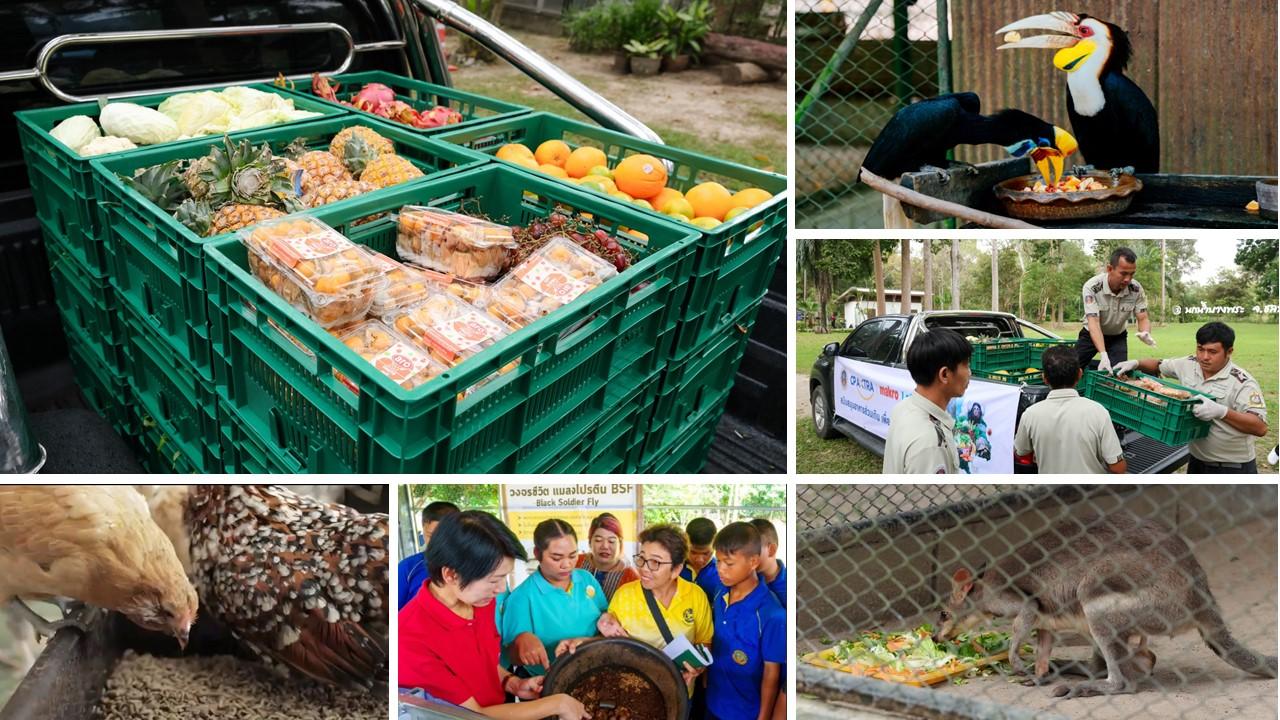
Donate the food surplus Project
This project aims to reduce food waste from retail store which cannot sale but still eatable to community nearby Lotus’s store (main format) in Bangkok and vicinity and foundation such as Scholars of Sustenance Foundation, V-VShare Foundation and Provincial Social Development and Human Security Office initiated from the pilot project. Furthermore, unsold food was donated to students of Chiang Mai Rajabhat University and Khon Kaen University to help reduce their cost of living.
2025 Result:
236.08 tons donate as food surplus (from stores in Malaysia) and 132.84 tons (stores in Thailand), total 368.92 tons
"EM Fermentation from Food Waste" Project
To reduce food waste to landfill by fertilizing the organic food waste, such as citrus fruits and pineapples, into bio-fermented water (EM) used to chemical free deodorize and degradable grease and oil in the sewer and floor at stores. Presently, 116 makro stores continue convert food waste to EM fermentation. Also donate food waste to be used for composting in the surrounding community.
2025 Result:
2,683.13 Food waste donation from convert to compost for community (wholesale 422.95 tons, retail 2,260.18 tons) 0.39 tons of food waste are converted to EM fermentation
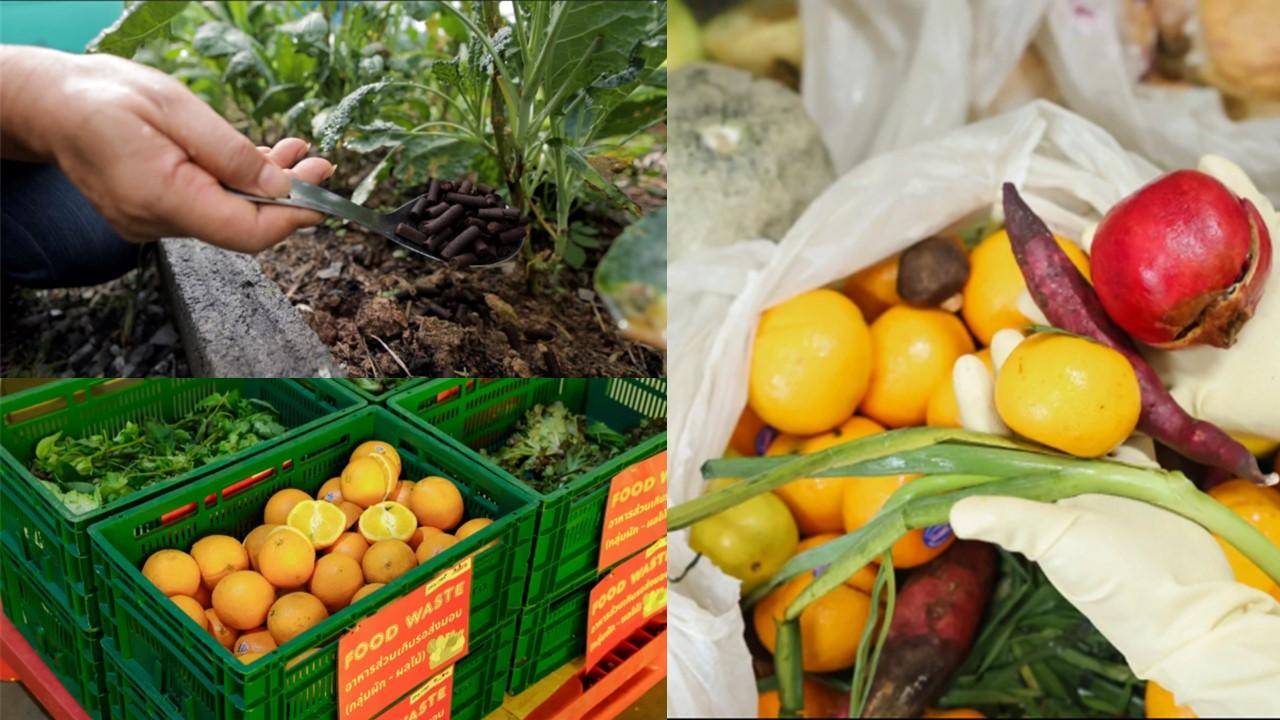
"Transition to Sustainable Packaging and Promotion of Circular Economy" Project
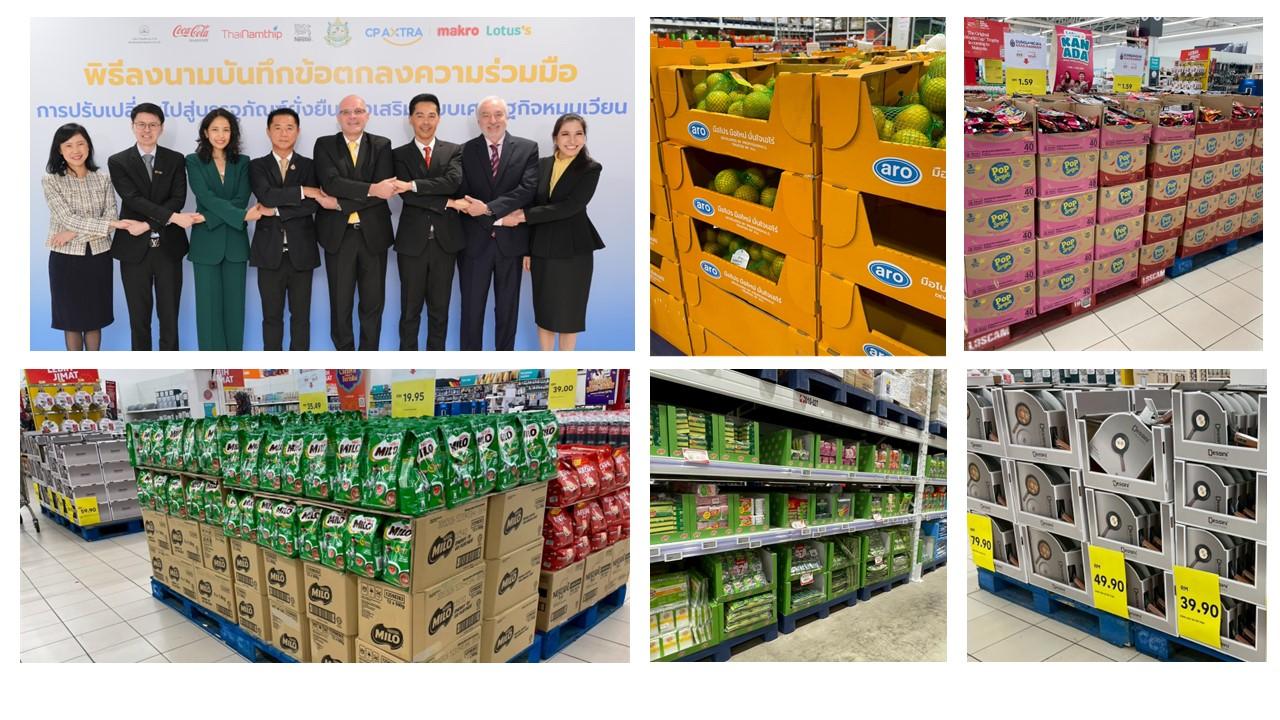
Beginning in 2024, the Company signed a Memorandum of Understanding (MOU) to transition toward sustainable packaging and promote a circular economy with four leading partners: Nestle (Thailand), ThaiNamthip Corporation, HaadThip PCL, and Patum Vegetable Oil. This aims to reduce environmental impacts through circular systems and sustainable or recyclable packaging. In 2025, the Company has expanded this project to all tier 1 suppliers to transition toward "Sustainable Packaging" using materials that are recyclable, biodegradable, reusable, or contain recycled content. This includes redesigning outer packaging under the "Shelf-ready-display" concept, as illustrated below, and using biodegradable promotional signs to create positive change for sustainability in Thailand’s retail industry.
"Sustainable Packaging Product" Project
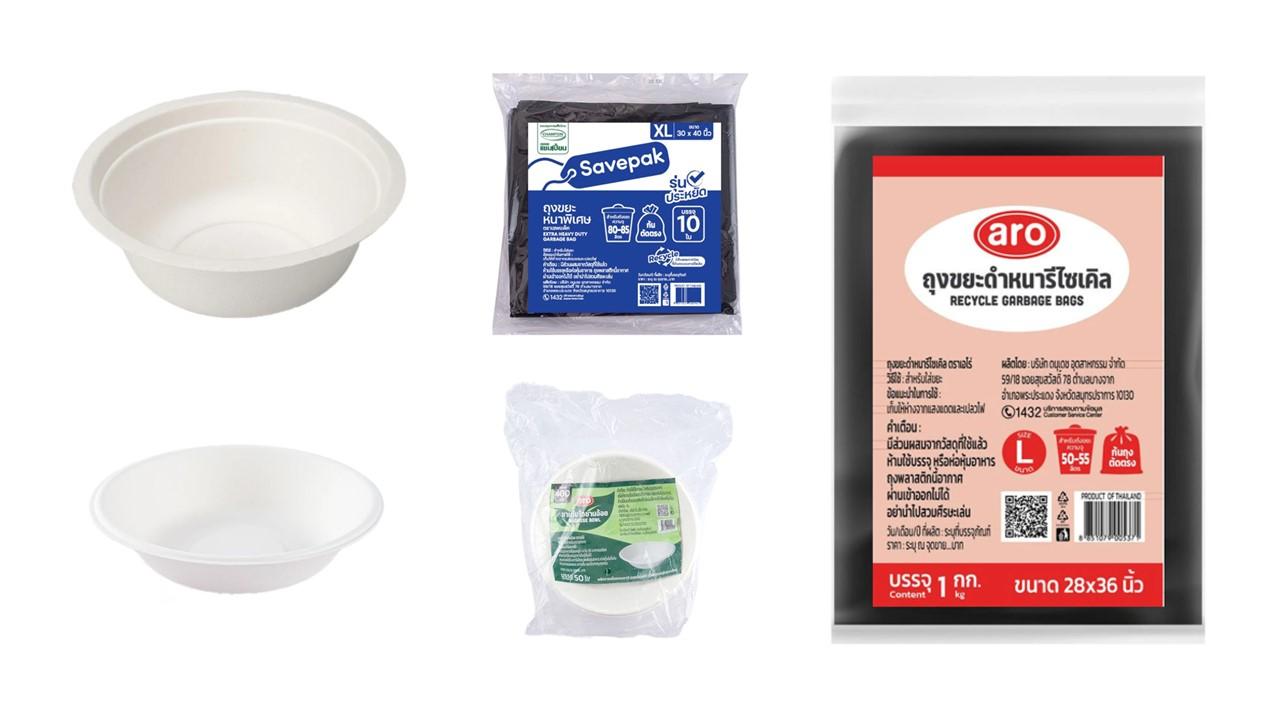
All stores announced to stop using single-use polystyrene (foam) food box in 2019. Together with continuously educating, promoting, and campaigning to the food business customers, and end consumers with the variable design and accessible prices, biodegradable packaging. With a collaborative partnership, can provide more than 530 designed items. Become the center of in Thailand and motivate sustainable consumer trends.
2025 Result:
Biodegradable packaging product is sold in 6,067.56 tons, or income increasing sales of 16.18% and income of 64,492,812.98 Baht.
4,315 tons of plastic waste from store is sent to be recycled content of new products (rPE garbage bag) and sold in the store. Improved recycled content rate 61% compared to last year (2024 = 2,680 tons) and increased sales = 48,349,737 Baht.
Recognition Award
- BEDO Award for the "Transforming Waste into Value for BSF Protein Insect Production Network" Project
- "Best Sustaining Partner Award 2025" from Scholars of Sustenance Thailand Foundation
GHG — Plan & Guidelines
Has a GHG Management Plan
Yes
Plan Description
Aiming for carbon neutrality by 2030 and achieving net-zero greenhouse gas emissions by 2050, the Company has implemented a 6 greenhouse gas management action plan as follows:
• Enhancing energy efficiency through various projects such as High-efficiency chillers, adoption of energy-saving lighting, high-efficiency air conditioning systems, energy-efficient building projects, energy-saving refrigerated etc.
• Utilizing clean energy, such as solar rooftop installations at stores and distribution centers, Solar thermal- water heaters, Solar tube technology in the headquarters building
• Adopting low-carbon refrigerants by transitioning to low-carbon alternatives like R290 and R-448A, along with preventive maintenance to reduce refrigerant leakage.
• Green vehicle such as: transitioning to electric forklifts, Utilizing electric and hydrogen-powered vehicles for product transportation
• Carbon absorption by planting perennial trees within operational areas and unused spaces.
• Compensating with high-quality and reliable carbon credit
GHG — Emissions
GHG Emissions
| Metric | Current Year | Previous Year | Two Years Ago |
|---|---|---|---|
| Total GHG emissions (Metric tonnes of carbon dioxide equivalent) | 12,602,075.96 | 10,649,909.61 | 8,829,847.48 |
| Total greenhouse gas emissions 1 (Metric tonnes of carbon dioxide equivalent) | 145,430.91 | 124,944.61 | 151,361.67 |
| Total greenhouse gas emissions 2 (Metric tonnes of carbon dioxide equivalent) | 764,399.39 | 739,871.9 | 714,098.94 |
| Total greenhouse gas emissions 3 (Metric tonnes of carbon dioxide equivalent) | 11,692,245.66 | 9,785,093.1 | 7,964,386.87 |
GHG — Emissions Verification
Emissions Verified by a Third Party
Yes
Verifying Body
2647
GHG — Principles & Standards
Principles & Standards Applied
| Standard |
|---|
| 2671 |
| 2672 |
| 2676 |
GHG — Targets
Has Set GHG Targets
Yes
GHG Targets — Net Zero
Net Zero Targets
| Emission Scope | SBTi Status | Base Year | Base Year Emissions | Near-term Target Year | Near-term Target Change (%) | Long-term Target Year | Long-term Target Change (%) | Target Year | Target Change (%) | Unit |
|---|---|---|---|---|---|---|---|---|---|---|
| 2717 | Commit | 2,021 | 173,238.53 | 2,030 | 20 | 2,030 | 20 | 2,030 | 20 | Metric tonnes of carbon dioxide equivalent |
| 2718 | Commit | 2,021 | 702,343.63 | 2,025 | 22 | 2,030 | 70 | 2,025 | 22 | Metric tonnes of carbon dioxide equivalent |
| 2719 | Commit | 2,021 | 6,745,627.38 | 2,030 | 25 | 2,050 | 90 | 2,030 | 25 | Metric tonnes of carbon dioxide equivalent |
GHG Targets — Carbon Neutrality
Carbon Neutrality Targets
| Emission Scope | Carbon Neutrality Certified | Base Year | Target Year | Target Change (%) | Unit |
|---|---|---|---|---|---|
| 2717 | N | 2,021 | 2,030 | 20 | Metric tonnes of carbon dioxide equivalent |
| 2718 | N | 2,021 | 2,030 | 22 | Metric tonnes of carbon dioxide equivalent |
| 2719 | N | 2,021 | 2,030 | 25 | Metric tonnes of carbon dioxide equivalent |
GHG — Performance & Outcomes
Has Performance Results
Yes
Performance Description
In 2025, the performance of many projects to reduce the greenhouse gases emission as follows:
• Enhancing energy efficiency through various projects such as High-efficiency chillers, adoption of energy-saving lighting, high-efficiency air conditioning systems, energy-efficient building projects, energy-saving refrigerator etc. which can avoid emission 1,878 tons CO2 equivalent which improved 715 tons CO2 equivalent from previous year.
• Utilizing clean energy, such as solar rooftop installations at stores and distribution centers, Solar thermal-water heaters, Solar tube technology in the headquarters building can increasing clean energy usage to 16.23%, up from 13.96% in the previous year increase which can avoid emission 142,624.89 tons CO2 equivalent which improved 48,268.13 tons CO2 equivalent from previous year.
• Adopting low-carbon refrigerants by transitioning to low-carbon alternatives like R290 and R-448A. But emissions increased by 20,163.66 tons CO2eq. This was driven by the 3-year maintenance cycle of refrigeration systems across branches in Thailand.
• Green vehicle such as: transitioning to electric forklifts, utilizing electric and hydrogen-powered vehicles for product transportation which can avoid emission 10,011.57 tons CO2 equivalent which improved 1,078.04 tons CO2 equivalent from the previous year.
• Carbon absorption by 7,204 planting perennial trees at our 119 stores.
Recognition award
- 2025 CDP Report achieved "B" rankings for Climate, Forest and Water
- Thaipat Institute's Sustainability Disclosure Award 2025 the 4th consecutive year, recognizing excellence in sustainability reporting on SDG Target 12.6. By adopting sustainable practices within business operations and integrating sustainability data into the Company’s annual reports.
-MEA Energy Awards continuous 5 years from the Metropolitan Electricity Authority (MEA) in Efficient Energy Use Building in 4 stores: Nakhon In, On Nut, Sanam Bin Nam, and Phet Kasem.
Environmental Legal Incidents
Legal Violation Incidents
| Metric | Current Year | Previous Year | Two Years Ago |
|---|---|---|---|
| Number of cases or incidents of legal violations or negative environmental impact (cases) | 0 | 0 | 0 |
Employees — Plan & Guidelines
Has an Employee Management Plan
Yes
Plan Description
Fair employee compensation
The performance management appraisal is conducted both individual and team-based performance. Starting from goal setting, monitoring, and reviewing annual performance in close collaboration with supervisors, promoting awareness of the existing strengths and weaknesses, thus the opportunities for professional growth to prepare effective, progressive professional developmental plans. Since 2023, the agile conversation is applied in the agile working teams. For the flexible objectives and quickly solves the barriers to the effective performance of agile team. This approach will focus on collaboration and regular conversations by bi-weekly and continuous feedback. The supervisor has frequently review employee's performance and development throughout the year.
Employee training and development
The company arranges the training curriculum that has been designed to support the necessary competencies and the skills such as compliance, functional, leadership and digital transformation skills including the emotional intelligence and systematic thinking skills from internal and external instructors to develop employee’s competencies, increase self-esteem and upskill the support business growth strategies. Example of training program such as;
• Online Business Model Training
To support the expansive growth of the omni channel model, employees and executives have developed digital skills through the e-training platform called "Axtra-iLearn" and workshop trainings. The objective of the program is to provide the knowledge of management processes and be able to work along value chain both online and offline business systems. The learning aim to integrate new tools such as AI, Power BI, Power Query, and Microsoft Copilot into daily workflows to boost efficiency to understand customer needs and pain points. This includes Prompt Engineering to simplify complex data analysis and project management with Microsoft Copilot to develop systematic data analysis for problem-solving, including Data Visualization, Analysis, and Storytelling for effective analytical and presentation skills. Currently, 1,808 participants have completed the program, generating 110,910.45 million Baht in online sales.
• Talent's Business Development Training
The Company's Business Academy is arranging the training program to suit the employee's job level to gain our employee knowledge and skills and also promote understanding of attributes and qualities that make a good leader who is able to drive business growth so as to make an advancement in their career path. The program comprises development program for manager and staff level. In 2025, the 122 employees or 100% has been participated the program and trained employees and supervisors can contribute the revenue more than 1,392.16 million Baht per year. The program participant contribute the revenue increasing 1.19 million Baht per year.
Promoting employee relations and participation
The Company engage employee through many programs such as physical and mental health advisory especially, the workplace stress management, annual engagement survey for improvement which the example welfare from employee's voice and became the welfare and benefit are as sport and health initiatives i.e. exercise gym, additional medical service, flexible working hour, the parental leave, lactation room, praying room, accessible for wheelchair, standby doctor at facility etc.
Enhancing employee's participation through the erection of staff representation for safety committee welfare committee. The Innovation Idea Project, to enhance employee create the way of working which presently has 5,834 innovators, includes volunteer activities and collaborations with local communities is 78,588 hours per year. The annual engagement survey in 2025, the target employee engagement score must more than 80% while the result is 85% which exceed the target that proven the employee is engaged with the Company in high level.
Migrant/foreign labor
The Company updates non-discrimination policy to cover the migrant worker and other form of contracted worker. All migrant worker received the training and development opportunity equality to local employee. Including, the employee's manual and all related form, document or sign board are updated to cover all migrant worker's language. Furthermore, all supplier and vendor has been trained nondiscrimination, diversity and inclusion also sign the commitment to comply with migrant work practice according to the Supplier's Code of Conduct.
Child labor
To ensure that no illegal child labor. The company and supply chain strictly follows the minimum employment age according to the local laws of the facility’s country or in the absence of law. As Thailand's regulation, the company prohibit hiring the under 15 years old and ensure that youth worker with an age younger than 18 years old are protected as law such as working not over 8 hours a day, and do not work the night shift (22.00 pm - 06.00 am). In addition, prohibit to assign the youth labor for the kind of work that may be harmful to their health and development, affecting their physical and mental state or compulsory education. The child labor practice also applies to all business partners along the value chain. In 2025, the company revise the supplier's code of conduct by adding the penalty statement and communicate along the supply chain.
Safety and occupational health at work
The company’s target for “Zero Lost time Injury within 2030”. To achieve this, occupational health and safety management system is implemented in all operational facilities to promote safe working conditions, equipment and machines, prevention and risk control program, safety training alongside personal hygiene and occupational illness preventive measurement of each operational area. In 2025, beyond the regulation, the Company’s recruit professional safety officer at every store site for more effective safety audit and inspection at site. The Company follows ISO 45001, with the 15 procedures for preventing work-related injury and occupational illness as well as proactively managing, SHE’s performance and continuous improvement and the Life Saving Rules are announced and implemented the whole organization with most strictly degree of protection. Including, add the new two performance indicators which are vehicle accident frequency rate and near miss reporting.
Plan Areas
| Plan Area |
|---|
| Fair employee compensation |
| Employee training and development |
| Promoting employee relations and participation |
| Migrant/foreign labor |
| Child labor |
| Occupational health and safety in workplace |
Employees — Workforce
Workforce Data
| Metric | Current Year | Previous Year | Two Years Ago |
|---|---|---|---|
| Total number of employees (Persons) | 69,173 | 73,969 | 64,645 |
| Number of male employees (Persons) | 28,540 | 32,150 | 26,442 |
| Number of female employees (Persons) | 40,633 | 41,819 | 38,203 |
| Total employment of disabled persons (people) | 184 | 198 | 203 |
| Total disabled employees (people) | 184 | 198 | 203 |
| Total male disabled employees (people) | 96 | 108 | 107 |
| Total female disabled employees (people) | 88 | 90 | 96 |
| Total disabled workers who are non-employee (people) | 0 | 0 | 0 |
| Contributions to the fund for promoting and improving the quality of life for disabled persons | 0 | 0 | 0 |
| Total number of male employees in operational level (Persons) | 24,593 | 28,194 | 22,451 |
| Total number of male employees in management level (Persons) | 3,879 | 3,894 | 3,937 |
| Total number of male employees in executive level (Persons) | 68 | 62 | 54 |
| Total number of female employees in operational level (Persons) | 34,762 | 35,791 | 32,202 |
| Total number of female employees in management level (Persons) | 5,805 | 5,952 | 5,954 |
| Total number of female employees in executive level (Persons) | 66 | 76 | 47 |
Employees — Remuneration & Provident Fund
Introduction
Annual employee compensation of Makro and Lotus (Thailand)
Remuneration & Provident Fund
| Metric | Current Year | Previous Year | Two Years Ago |
|---|---|---|---|
| Total disabled employees (people) | 22,985,303,311 | 22,167,490,849 | 21,374,323,677 |
| Total male employee remuneration (Baht) | 9,658,206,822 | 9,434,698,902 | 8,963,077,188 |
| Total female employee remuneration (Baht) | 13,327,096,489 | 12,732,791,947 | 12,411,246,489 |
| Number of employees eligible to participate in PVD (persons) | 69,173 | 73,969 | 0 |
| Total number of employees joining employee provident fund (Persons) | 48,957 | 54,250 | 0 |
| Percentage of total number of employees joining employee provident fund to total number of employees (%) | 70.77 | 73.34 | 0 |
| Number of PVD members / Total eligible employees (%) | 70.77 | 73.34 | 0 |
| Total amount of provident fund contributed by the Company (Baht) | 562,190,839 | 573,482,048 | 0 |
| Total amount of provident fund contributed by employee (baht) |
Employees — Training & Development
Training Data
| Metric | Current Year | Previous Year | Two Years Ago |
|---|---|---|---|
| Average employee training hours (Hours / Person / Year) | 21.9 | 22.73 | 47.3 |
| Employee development and training expenses (baht) | 1,232 | 892.84 | 1,190.6 |
Employees — Occupational Health & Safety
Occupational Health & Safety Data
| Metric | Current Year | Previous Year | Two Years Ago |
|---|---|---|---|
| Total number of lost time injury incidents by employees (Cases) | 290 | 313 | 228 |
Employees — Labour Relations
Labour Relations Data
| Metric | Current Year | Previous Year | Two Years Ago |
|---|---|---|---|
| Total voluntary resignations (Persons) | 23,874 | 20,821 | 22,623 |
| Male employees who voluntary resigned (Persons) | 9,627 | 8,363 | 8,676 |
| Female employees who voluntary resigned (Persons) | 14,247 | 12,458 | 13,947 |
| Percentage of employee turnover leaving the Company voluntarily (%) | 34.51 | 28.15 | 35 |
| Evaluation result of employee engagement | 1 | 1 | 1 |
Employees — Employee Representation
Employees Are Represented Collectively
Yes
Forms of Representation
| Form |
|---|
| Welfare committee |
Employees — Targets
Has Set Employee Targets
Yes
Targets
| Indicator | Target Areas | Target Year | Target Year — Description |
|---|---|---|---|
| Provide the training and skill development to employee | 2984 · Description: Employee training and development | 2,025 | 100% |
| Employee's engagement | 2985 · Description: Promoting employee relations and participation | 2,025 | greater or equal 80 |
| Illegal child labor breach case in own operation and supply chain | 2987 · Description: Child labor | 2,025 | Zero |
| Lost time injury case | 2988 · Description: Safety and occupational health at work | 2,025 | Zero |
| Gender equity payment ratio | 2989 · Description: Non-discrimination | 2,025 | gap less than 5% |
Employees — Performance & Outcomes
Has Performance Results
Yes
Performance Description
Recognition awards
Labor practices awards
- Award of HR Asia Best Companies to Work for in Asia 2025 - Thailand by HR Asia, recognizing excellence in HR management, employee engagement, and a culture that empowers everyone to demonstrate their potential and grow.
- Award of Top Employer 2025 in Thailand for the 3rd consecutive year by the Top Employers Institute, Netherlands, for world-class HR standards, awarded to Lotus’s retail business under CP Axtra Public Company Limited.
Occupational health, safety, and working environment awards
- In 2025, 28 branches received the National Outstanding Model Establishment Award from the Ministry of Labor,
- and 220 branches plus 7 distribution centers received the 2025 Safe Workplace Award for reducing lost-time accidents. Social supporting awards
- Retail Asia Awards 2025: ESG Initiative of the Year – Thailand, recognizing the Company’s commitment to job and income creation for communities via the “Platform of Opportunity” to ensure transparency and expand partnership opportunities for farmers and SMEs.
Fair employee compensation
Target: All employee has proper performance evaluation and fair payment
2025 Result: Achieved target, 100% which compliance with regulation and sufficient for their living.
Furthermore, the company is creating a flexible working environment that is conducive to work efficiency and adaptability to fluctuating requirements and thus commenced hybrid working to facilitate a variety of working environments that encourage outcome-based achievements and appropriate time-management among employees with flexible office location or working-hour, and strategic adjustment under the digital transformation. Presently, there are 4% of Traditional working time, 1% of Flexible Working Hours, 8% of Work from Home / Anywhere and 87% of Shift pattern.
Employee Supporting Program
The company provides facilities and programs such as annual health check-ups, by specializing occupational health-safety doctors and Stress counselling by psychologist, annual physical checkup, alternative (Chinese) medical consultation, medical benefits to all employees and sport facility and health promotion programs.
Furthermore, the supporting the employee's family condition either, the company provides the privacy lactation room with proper furniture, air conditioning and refrigerator, even contracted day time child center and leave day to take care family which are
7 weeks for paid parental leave for the primary caregiver
1 week for paid parental leave for the non-primary caregiver
7 days for paid family or care leave beyond parental leave (care given for a child, spouse, partner, dependent, parent, sibling, or other designated relation with a physical or mental health condition).
Employee training and development
Target: Employee has trained and engaged in development and initiatives program.
2025 Result: Achieved target, 100% has been trained and participated the program
Promoting employee relations and participation
Target: Score of annual employee engagement survey not less than 80%
2025 Result: Achieved target, annual employee engagement score = 85%
Migrant worker
Target: Migrant worker received benefit, welfare and opportunity of training development equal to local employee
2025 Result: Achieved target, Zero breach case
Child labor
Target: Zero breach case of illegal child labor
2025 Result: Achieved target, Zero breach case
Diversity & Inclusion, Non-discrimination and Gender Equity
The company respects diversity and inclusion where employees, worker, supplier and vendor are treated with fairness, without any discrimination from the race, nationality, color, ethnicity, religion, social status, gender, age, physical features or disability, political belief and marital status.
Target: Women in management position (first level, middle and top) not less than the %Women in total workforce (59%)
Result 2025: Achieved the target which the result as 61% with the detail as below table as
result in % Women workforce in each level | vs global industrial sector |
59% Women in total workforce | 46% - 53%1 |
61% Women in management position (first level, middle and top) | 33% - 40% |
46% Women in Top management | 25% - 29%2 |
57% Women in Middle management, | 33% - 40% |
63% Women in first management | 42% - 48% |
57% Women in revenue generating function, | 20% - 24% |
38% Women in STEM (Science, Technology, Engineering and Mathematics) | 22% - 28%3 |
Note:
1 World Economic Forum (WEF), Global Gender Gap Report 2025.
2 McKinsey & Company, Women in the Workplace 2025 (Retail Sector Analysis).
3 International Labour Organization (ILO), Statistics on Women in STEM (Retail Tech Focus) 2025.
Non-discrimination
Target: Average gender pay gap, does not exceed 5%
2025 Result: Achieved target, gender gap only 4.67% which achieved the target
Gender Pay Indicators
The Company also conducts equal payment analysis to ensure that both men and women are paid equally fair, including the annual reviewing for compensation and benefits at competitive rates with benchmarking in the same industry and leading company. The data are verified by Third party assurance (on last page of attachment#9 - the assurance statement).
Payment Ratio by gender (Female : Male)
• Executive level (base salary only) = 0.73: 1.00
• Executive level (base salary + other cash incentives) = 0.70: 1.00
• Management level (base salary only) = 0.89: 1.00
• Management level (base salary + other cash incentives) = 0.89: 1.00
• Non-management level (base salary only) = 1.00: 1.00
Difference between men and women employee (%) are calculate from below formular which are
• Mean gender pay gap = [Male’s mean payment - Female’s mean payment] / Male’s mean payment
2025 Result = 4.67%
• Median gender pay gap = [Male’s median payment - Female’s mean payment] / Male’s mean payment
2025 Result = -1.93%
• Mean bonus gap = [Male’s mean bonus - Female’s mean bonus] / Male’s mean bonus
2025 Result = 4.55%
• Median bonus gap = [Male’s mean bonus - Female’s mean bonus] / Male’s median bonus
2025 Result = -5.00%
Note: The coverage of the data reported as a % of FTEs = 100%
Facility and supporting for employee, diversity and inclusion
Design for wheelchair and aging.
Lactation Rooms for mother
Prayer rooms for Religions
Employee engagement survey
In 2025, the employee engagement resulted in a score as high as 85%. from 100% employee response the survey as detail score in dimension as;
85.53% Job satisfaction (external motivation, e.g. I am satisfied with my job)
85.73% Purpose (internal motivation, e.g., my work has a clear sense of purpose)
84.60% Happiness (e.g., I feel happy at work most of the time)
83.10% Stress (e.g., I feel stressed at work most of the time)
Safety and occupational health at work
Results of annual plan implementation:
- 498 near miss cases are reported by employee which 100% are investigated and closed the correction and prevention action.
- 100% of key areas and activities have been identified and assessed, covering new business units, changes, normal conditions, abnormal conditions, and crisis. In 2025, the 5 hazards have been identified, assessed, and prioritized and all risks level as moderate or higher have been reported and updated the action progress to the Risk Management Committee every quarter.
- 100% of all areas conducted annual fire drills and evacuation exercises, including drills for business continuity plans such as flood response and pandemic response plans.
- 100% of areas in retail centers and warehouses across all branches undergo daily safety inspections.
- Applied AI technology integrated with CCTV to detect unsafe behaviors.
- 100% of employees and executives have been trained on accident reporting. Witnesses must report incidents to their supervisors within 24 hours, and senior executives in each area investigate the incidents, define corrective and preventive measures, and follow up until completion.
- 100% of employees have completed basic safety training and job-specific safety training, such as forklift operation training, defensive driving, PPE usage, basic firefighting, etc. Additionally, branch managers communicate safety messages and conduct daily area inspections to raise safety awareness among employees and contractors.
Safety statistics
Target: Zero fatality case
2025 Results: 2 employee fatality cases and 2 contractor fatality cases
-Employee fatality cases: Two road accident cases, one is caused by the motorbike speed controller has malfunctioning on the road. And another case is motorbike was hit by truck. Preventive measures for both cases include defensive driving training to understand blind spots and adding vehicle inspection checklists before operation.
-Contractor fatality cases: First case as the electricity shock that caused by improperly modified the wiring and another case is the grease trap explosion resulted from bypassing Hot Work and Confined Space permit procedures. Corrective action for both case is enforcing the life-saving rules and work permit procedure as personnel selection, energy isolation, gas detector, and deploying onsite safety inspector as the procedure.
Customers — Plan & Guidelines
Has a Customer Management Plan
Yes
Plan Description
Responsible Production and Customer Service, and Communication of Product and Service Impact to Customers/Consumers
Quality Control and Product Information
The Company places great importance on food quality and safety throughout the supply chain operations. The company has established food safety guidelines from upstream to downstream as follows:
Upstream: Enhancing Safety from the Farm Level.
The company sets guidelines for environmentally friendly agricultural production, prioritizing consumer safety. It promotes quality certifications such as GAP, Thai GAP, GLOBAL G.A.P., and organic farming standards. The company provides knowledge and understanding to farmers and partners to improve production processes, enabling them to achieve these certifications. This ensures the production of high-quality, safe, and traceable products under the MQP (Makro Quality Pro), aro Gold, and Selected brands, which can be traced back to their origins.
Midstream: Quality Control and Food Safety
The company maintains a sustainable food safety and quality management system across the supply chain, selecting partners from farmers to SMEs who meet standards like GMP and Livestock OK. Our quality control process ensures products are tested by certified laboratories, while our distribution centers hold ISO 22000 and GHP certifications to guarantee safety standards. These measures ensure comprehensive quality control from sourcing, collection, and packaging through to final distribution, providing full confidence in every product.
Downstream: Traceability and communication of product impact
Beyond traditional labeling, consumers can access product data via QR Codes to trace the origins, nutrition, healthy recipes, ingredients, warnings, and impacts. The company implemented the "i-trace" system across wholesale and retail sectors for fresh food—including bakery, fruit & vegetable, meat, and seafood—and own brand products. This enables consumers to scan QR Codes for sourcing, production standards, nutritional facts, instruction and warning for safe consumption.
Customer satisfaction and relationship development
Presently, the customers vary by age, income, and household size. To grasp consumption patterns, the Company’s has worked with professional partner to conduct the annual customer satisfaction survey and research the behavior of each customer segment to develop product strategies, plan product sales through both online and offline, and an effective marketing plan. To build and maintain customer relationships, the loyalty program as makro PRO POINT and lotus’s Coin are introduced to enable customers to collect points from their purchasing. which member has privilege discounts and coupons, and other promotions, as well as a convenient medium for direct communication with customer service. In 2025, the annual customer satisfaction score was 86% which exceed the target that has set as at least 80%
Personal Data Protection
The Personal Data Protection Law sets forth the standards, practices, and obligations that the Company must adhere to when managing or processing personal data. These guidelines apply to all personal data, including that of customers, employees, and stakeholders. To comply with relevant practices and responsibilities, the Company must process personal data according to the following principles:
• Process personal data in a fair and lawful manner.
• Process personal data in accordance with the purposes for which it was collected, used, or disclosed.
• Ensure that personal data processed is adequate, relevant, and not excessive.
• Ensure personal data is accurate and up to date.
• Do not retain personal data longer than necessary
• Process data in accordance with individuals' rights to access and correct their data.
• Ensure personal data is kept secure.
• Personal data must not be transferred to countries with inadequate data protection standards, unless consent is obtained or as required by law.
• Personal data must be used correctly and in a way that does not cause harm to the data subject
The Company has established standards, practices, and processes to support compliance with this policy. The subsections below summarize the key aspects of data protection that the Company must always consider when processing personal data. find more detail at https://www.cpaxtra.com/th/personal-data-protection-policy
Plan Areas
| Plan Area |
|---|
| Responsible production and services for customers |
| Communication of product and service impacts to customers/consumers |
| Development of customer satisfaction and customer relationship |
| Protection of customer personal information |
Customers — Satisfaction Results
Customer Satisfaction Results
| Metric | Current Year | Previous Year | Two Years Ago |
|---|---|---|---|
| Evaluation results of customer satisfaction | 1 | 1 | 1 |
Customers — Targets
Has Set Customer Targets
Yes
Targets
| Indicator | Target Areas | Target Year | Target Year — Description |
|---|---|---|---|
| Customer impact from consume product and service | 3007 · Description: Responsible production and services for customers | 2,025 | Zero Case |
| Score of customer satisfaction survey | 3009 · Description: Development of customer satisfaction and customer relationship | 2,025 | greater or equal 80% |
Customers — Performance & Outcomes
Has Performance Results
Yes
Performance Description
• Responsible production and services for customers
Target: Zero customer impact from consume product and service
2025 Result: 6 cases
• Communication of product and service impacts to customers/consumers
Target: Zero customer complaint related to the non-compliance labelling
2025 Result: Achieved target, zero customer complaint case that related to the non compliance labelling
• Development of customer satisfaction and customer relationship
Target: Score of annual customer satisfaction survey not less than 80%
2025 Result: Achieved target, the customer satisfaction score = 86%
Performance of Quality Control and Product Information
In 2025, the company has continued to enhance knowledge on agricultural production for farmers, SME partners, and community enterprises, enabling them to achieve various certifications. As a result of these efforts, 507 farmers, SME partners, and community enterprises have now been certified. These entities have delivered over 925 agricultural products under the MQP (Makro Quality Pro), aro Gold, and Selected labels. Additionally, the company has upgraded 990 agricultural packing facilities to meet GMP* standards and developed 24 chemical screening laboratories certified for quality toxin inspection systems**, covering all regions. Furthermore, the company has improved 2 of its distribution centers to achieve certifications for toxin inspection systems**, ISO 22000***, and GHP***. The i-Trace system now covers over 12,000 items of fresh food and bakery products, representing 100% of the food products under the Aro brand. This initiative has raised awareness about nutrition and health, with over 209,254 visits to the platform.
Notes:
* Certified by the Food and Drug Administration (Thailand-FDA)
** Certified by the Department of Medical Sciences
***Certified by Bureau Veritas (Thailand) Ltd.
Community & Social — Plan & Guidelines
Has a Community & Social Plan
Yes
Plan Description
Employment and Professional Skills Development Program
One of the company’s core missions is to be beloved and create benefits for communities in every area where it operates. This is achieved through various activities, such as local employment, supporting farmers, small entrepreneurs, and vulnerable groups, as well as promoting local economies. The company provides knowledge on retail business management to small grocery store owners and small-to-medium-sized food businesses to connect networks, strengthen the community's economic foundation, and assist communities during crises. Furthermore, the company supports agricultural products from local farmers and small entrepreneurs in various regions, continuously developing their potential to achieve standardized production to ensures high-quality, safe food products and sustainable income.
Another key mission is to empower small-scale entrepreneurs within the community, such as local shops, restaurants, or street food vendors, to adapt and thrive sustainably. By leveraging insights gained from working closely with these small business owners, we have established a learning institute for entrepreneurs and the local community. This allows them to enhance their professional skills free of charge through ongoing projects.
"Makro Retailer Alliance" Project
For the 18th consecutive year, the wholesale business unit-makro has been developing the skills of small grocery store owners through the "Makro Retailer Alliance" project. This initiative supports and enhances the potential of grocery stores, from opening new stores to improving existing ones, through the "8 Steps to Success" curriculum. Upskill with digital knowledge, AI and new technology skills which are accessible at makro branch or online at the company’s website and social media. Additionally, the project offers free business consultations and problem-solving support. Currently, 12,308 people have participated in the project.
"Chef's club by makro" Project
The project is a comprehensive support program for food entrepreneurs. It provides knowledge to individuals interested in starting or improving Hotel, Restaurant, Catering businesses, restaurants, or street food ventures. The program covers all step, from ingredient preparation and recipe development to pricing, marketing, and promotion. Courses such as social media marketing and street food Recipes. The program also offers professional training and member-exclusive product prices, benefiting 179,593 participants, with average sales growth of 11% from last year.
Scholarship for student
The company donate the scholarships to 1,145 students, total 101,187,300 Baht.
Forest and Nature Protection
The Company has donated inedible surplus food to 18 animal conservation centers and zoos under the Department of National Parks, Wildlife and Plant Conservation, Ministry of Natural Resources and Environment. Amount of donation as 1,117.38 tons per year
Sports, Water management and Access to Clean Water
To support community exercise free of charge, Lotus's retail business has upgraded its signature "Lotus’s Aerobic Dance Fit & Fun" project to reach more people by expanding to 100 branches nationwide, providing venues, equipment, professional trainers, and health influencers. The project also offers free basic health screenings, such as diabetes, BMI, muscle mass, and bone mass checks, to raise community health awareness. In December 2025, Lotus’s at Bangna launched a new concept as a "Happiness and Health Destination," featuring fresh, clean, and safe food, daily freshly cooked meals, and apparel made from recycled plastic. It also offers pharmacist consultations for medicine and supplements, exercise areas like gyms or basketball courts, and free clean water refill stations to ensure access. This branch serves as a model for future nationwide upgrades next year.
Support for Vulnerable Groups
Create Jobs, Create Careers, and Promote Careers for People with Disabilities Nationwide": In collaboration with the Department of Empowerment of Persons with Disabilities, the company has been supporting skill development and products for people with disabilities for 4 consecutive years. This year, the company purchased 79,542 bamboo baskets for fruit baskets sold in stores, creating sustainable income for disabled individuals and their families.
“60+ Heart-Filling” Project
During September – October 2025, Lotus’s organized activities exclusively for seniors, including free health screenings, blood pressure checks, and pharmacist consultations at over 200 Lotus’s Pharmacy branches. The program offered special privileges and discounts on fresh food and healthy promoting products for members aged 60 and over. Additionally, recreational activities such as free karaoke singing to support mental well-being and foster a vibrant community for the elderly.
Reducing Social Inequality
"Platform of Opportunity": This initiative includes Business Matching activities to expand opportunities for SMEs and farmers to present their products to the company. The program aims to elevate product standards, improve production quality, and prepare them for export markets. In 2025, the 205 entrepreneurs applied, and 36 products were selected and sold at stores. see more detail at link https://cpseeding.com/cpaxtra
Plan Areas
| Plan Area |
|---|
| Employment and professional skill development |
| Education |
| Forests and natural resources |
| Sports and recreation |
| Occupational health, safety, health, and quality of life |
| Disadvantaged and vulnerable groups |
| Water and sanitation management |
| Reducing inequality and promoting social equality |
Community & Social — Targets
Has Set Community & Social Targets
Yes
Targets
| Indicator | Target Areas | Target Year | Target Year — Description |
|---|---|---|---|
| create job or career that generate income to community | 3036 · Description: Employment and professional skill development | 2,025 | Greater or equal to 219,000 people |
| Number of people are supported through education, lifelong learning and upskilling | 3037 · Description: Education | 2,025 | Not less than
190,000 people |
Community & Social — Performance & Outcomes
Has Performance Results
Yes
Performance Description
Employment and professional skill development
Target: Direct and indirect job creation not less than 219,000 people
2025 Result: Achieve target, 252,274 people are directly and indirectly hired
Direct income support through employment or raw material purchases:
- 73,281 individuals were employed or had their raw materials purchased.
- 19,268 farmers and SMEs received product support.
Indirect income support through employment in the supply chain:
- 57,446 individuals employed by SMEs and farms.
- 102,279 individuals employed by contractors.
The Company has continuously supported agricultural products from local farmers and small-scale entrepreneurs across various regions. This includes enhancing the potential of our partners to upgrade their production to meet standards, ensuring high-quality and safe food products while providing stable income.
2025 Result: Local product purchases totaled 396,530,978,145.14 Baht, which is 96% of total amount purchasing.
- 682.21tons of meat and alternative protein products, worth 162million Baht.
- 6,323.11tons of organic chicken, eggs, and milk, worth 566million Baht.
- 15,242.74tons of seasonal fruits, worth 881million Baht.
- 56,665.18tons of vegetables and local herbs, worth 1,921million Baht.
- 15,464.33tons of aquatic products and seafood, worth 6,174million Baht.
- 188 SKUs of local and OTOP products, worth 923,332 Baht.
• Education and lifelong learning to reducing inequality
Target: Number of people are supported the education, lifelong learning and upskilling; not less than 150,000 people
2025 Result: Achieved target, 191,901 people are supported education, lifelong learning and upskilling
Other Social Management
Plan & Outcomes — Description
Responsible Supply Chain Management
The Company commits to leverage the ESG along the supply chain with all suppliers. With focused supply chain ESG program that assess potential ESG risks, and consequently, plan remedial measures to assure sustainability performance along the supply chain. The Company integrated Supplier’s ESG development with the business strategy and closely monitoring performance. Including clearly communicate and engage the ESG target to all suppliers and all suppliers must comply with ESG assessment score at least 33% without any major concern before starting the business with The Company.
Supply Chain Management Program
Supplier’s Code of Conduct
The Supplier’s Code of Conduct manual and training VDO with subtitle are publicly on The Company’s website and applied to all suppliers across all countries. All the suppliers must be trained and sign an acknowledgment by their top management or assignee to accept these ESG criteria as the business contract terms and conditions
Target: All Tier-1 and non Tier-1 supplier signed acknowledgement and trained the Supplier Code of Conduct and all related staff has trained in their roles in the supplier ESG program
2025 Result:
• Achieved target, 100% Tier 1 suppliers and non-tier 1 suppliers signed acknowledgment and trained.
• Achieved target, 100% Buyer, QA, and Operation are trained in their roles in the supplier ESG program.
Supplier Screening
The significant supplier is a supplier that is identified as a potential sustainability risk supplier. The screening of the significant suppliers by reviewing potential or actual suppliers’ risks of the negative ESG impacts and also business relevance risks or a combination of both. The risk covers factors of country, sector, and commodity-specific risks are considered, below is the Company's criteria for supplier ESG screening as
Business relevance criteria: | Governance & Compliance criteria: | Environmental criteria: | Social Aspect criteria: |
|
|
|
|
2025 Result of KPIs for Supplier Screening
Total number of Tier-1 suppliers = 3,490 suppliers
Total number of significant suppliers in Tier-1= 1,049 suppliers
Total spend on significant suppliers in Tier-1 = 63.52%
Total number of significant suppliers in non-Tier-1 = 3 suppliers
Total number of significant suppliers (Tier-1 and non-Tier-1) = 1,052 suppliers
Supplier Assessment & Development Process
Purchasing practices towards suppliers are continuously reviewed to ensure alignment with the Supplier Code of Conduct and to avoid potential conflicts with ESG requirements.
• Online Assessment:
- All supplier must pass the ESG desk assessments which is the systematic verification of evidence on the company’s digital platform and transparent scoring. The assessments follow SMETA and ISO 17025 and ISO 20400.
- All suppliers are informed of the exclusion from contracting if they cannot achieve minimum ESG requirements within the set timeframe (score >33% before starting or > 55% within 2.5 years to continuing the business). Suppliers with better ESG performance are preferred by applying a minimum weight to ESG criteria in supplier selection and contract awarding.
• Onsite Audit:
- Any supplier who has low score (< 33%) and/or potential ESG risk in any criteria i.e. product safety & quality, human rights, labor practices, environment impact or breach case with community, etc. will be conducted the on-site assessments which carried out by the company’s audit team and/or independent accredited auditing body (3rd party assessment). The high-risk supplier must have the corrective action and improvement and quarterly update their progression to the company.
Result of Supplier Assessment and Development Programs
Coverage and progress of supplier assessment program as following;
• Supplier Assessment:
Target: Total number of suppliers assessed via desk assessments/on-site assessments
Result : Achieved target as
- 100% of significant supplier are assessed (3,490 suppliers)
- 104 suppliers assessed with substantial actual/potential negative impacts, anyway 99.04% suppliers of this group are agreed corrective action/improvement plan while only 1 supplier has been terminated according the unqualified issue.
• Corrective action plan support:
Target : 100% of suppliers assessed with substantial actual/potential negative impacts completed the correction.
2025 Result: Achieved target, 100% of suppliers assessed with substantial actual/potential negative impacts completed the correction.
• Capacity building programs:
Target : 100% % of unique significant suppliers in capacity building programs
2025 Result: Achieved target, 100% of unique significant suppliers (1,110 suppliers) in capacity building programs that detail as
-100% significant supplier are trained the company's ESG program, process and requirement
-100% Supplier support on the implementation of corrective/improvement action
-119 suppliers participated the In-depth technical support programs
The supplier's related data in this topic, has been third-party verified. See the 3rd party's assurance statement on the last page of attachment#9 of this report
Promoting the Sustainability Certified Product
The Company enhance and integrate the requirement of the sustainability certification products into the procurement process. for example.
Sustainable Fisheries Project
The Company is committed to developing sustainable fishery products that meet international standards, such as ASC (Aquaculture Stewardship Council) and MSC (Marine Stewardship Council). These certifications ensure a robust Chain of Custody, guaranteeing that our products are sourced from quality-assured, environmentally responsible, and sustainable fisheries. Furthermore, our system enables full traceability across the entire supply chain, back to the original source of the aquatic resources. Currently, more than 200 items have been certified under MSC or ASC standards. In 2025, the purchase value of these certified products greater than 7 billion Baht, accounting for 44% of the total seafood procurement.
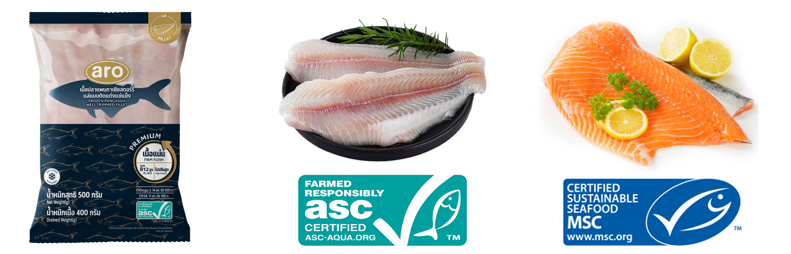
Also "aro" and “ocean gems” which are the own brand products has 42 items which are certified by Marine Stewardship Council (MSC) and Aquaculture Stewardship Council (ASC) in the 6 product categories which are fish, crab, shellfish, shrimp, squid, and roe. The certificate are posted on the company's website which accessible through below links
https://www.cpaxtra.com/storage/document/sustainability/asc-certificate.pdf
https://www.cpaxtra.com/storage/document/sustainability/msc-certificate.pdf
Promoting the Animal Welfare and organic products
The company’s commitment and engagement to animal product suppliers must be audited and qualified with QA and product safety criteria before trading and reassessment every 3 years to ensure the product is safe for consumers.
2025 Result: Achieved target which detail as;
• 100% supplier not to use the antibiotics
• 100% supplier not to use GMO or cloned animal
• 100% supplier Not to apply growth-promoting substance
• 100% supplier are audited every 3 year and lab sampling in every product lot.
• 36.14% Share of organic products per total fresh food products which is increased compared last year. (2024 = 33.82%)
Law Violation Incidents
Law Violation Incidents
| Metric | Current Year | Previous Year | Two Years Ago |
|---|---|---|---|
| The total number of cases or incidents of significant violations of laws or regulations regarding social and human rights (Cases) | 1 | 0 | 0 |
| The total number of cases or incidents that cause significant labor disputes (Cases) | 0 | 0 | 0 |
| The total number of cases or complaints related to consumer rights violations (Cases) | 0 | 0 | 0 |
| The total number of cases or complaints related to partner rights violations (Cases) | 0 | 0 | 0 |
| The total number of cases or incidents that cause disputes with the community/society (Cases) | 0 | 0 | 0 |
| The total number of cases or incidents related to cyber security or customer data breaches (Cases) | 1 | 0 | 0 |
| The total number of cases or incidents related to safety and occupational health at work (Cases) | 0 | 0 | 0 |
Law Violations — Case Detail & Corrective Measures
Incidents & Corrective Measures
| Year | Incident Detail | Status | Remediation Measures | Non-financial Impact |
|---|---|---|---|---|
| 2,025 | Unauthorized access to customers’ basic personal data (excluding sensitive information or any financial data) | Incident no longer subject to action | Executed the action plan to fully block access and protect customer data. Partnered with world-class experts to immediately enhance overall system security. Notified customers of the incident and guidelines. Reported to governmental authorities. | Reputation and cybersecurity risk |